

 English
 العربية
 Español
 Русский
Industry News
Industry News

When a bank branch loses power, the stakes are immediate and measurable: teller terminals go dark, ATM networks drop offline, vault security and CCTV systems fall back to batteries with limited runtime, and customers queue outside a building that cannot process a single transaction. Financial institutions are among the most downtime-sensitive businesses in the world — which is why a correctly specified standby diesel generator is not an optional accessory but a core part of branch infrastructure. This guide explains how banks, credit unions, microfinance companies and ATM network operators should assess, size, configure and procure an emergency diesel generator, including what to check when buying from a China diesel generator manufacturer.
Table of Contents
Many branch managers assume a UPS (uninterruptible power supply) solves the outage problem. It does not — and confusing the two is the most common mistake in financial facility planning.
A UPS provides clean power for seconds or minutes, just long enough for computing equipment to shut down safely or for a generator to start. A typical branch UPS holds 5–15 minutes at full load. A grid failure that lasts an hour — caused by storms, transformer faults or utility load shedding — will exhaust any reasonably sized UPS bank. Only a diesel power generator provides unlimited runtime as long as fuel is available, making it the true source of branch resilience.
Best practice for financial facilities is a three-layer architecture. Layer one is the UPS, which protects servers, network gear and transaction systems from milliseconds-long sags and surges. Layer two is the auto-start diesel generator, which carries the entire branch load within 10 seconds of a mains failure. Layer three is disciplined fuel and maintenance management, which guarantees layers one and two actually work when called. All three layers are needed; removing any one creates a single point of failure that regulators and customers will eventually notice.
Central banks and banking associations in many countries require documented business continuity plans for branch operations, including power resilience. Extended outages can trigger service-level penalties for ATM availability and online banking uptime, and in cash-dependent economies a dark branch quickly becomes a security risk as crowds form. A reliable diesel genset converts these risks into a routine, testable engineering control.
Sizing a generator for a bank starts with an honest inventory of what must keep running. Bank loads are unusual because they combine dense electronics with a handful of hard-starting motors.
| Load Group | Typical Items | Notes |
|---|---|---|
| IT & transaction | Servers, core banking terminal, network switches, UPS input | Sensitive to voltage and frequency variation; served via UPS |
| Customer service | Teller PCs, printers, queuing displays, lighting, air conditioning | Comfort and continuity loads, 8–12 hours daily |
| Security | Vault door, access control, CCTV, alarm panels, perimeter lighting | Must never drop; often on dedicated circuits |
| Motor loads | HVAC compressors, fresh-air fans, small pumps, roller shutters | Starting current 3–6× running current; drives sizing |
The HVAC compressor is usually the largest single load in a branch, and if it starts Direct-On-Line (DOL) it can demand four to six times its rated current. A generator sized only for running load will suffer voltage dip and possible breaker trips every time the compressor restarts. Either size the power generator with a surge margin for DOL starting, or fit the compressor with a soft starter / VFD — which typically lets you downsize the genset by one frame class and recovers the soft starter cost quickly.
The same logic applies to smaller facilities. A compact branch or currency exchange operating on a 32kW silent diesel generator still benefits from staged load transfer — critical loads first, comfort loads 30 seconds later — to avoid inrush overload. A typical 32kW silent genset covers the IT, security and lighting load of a small branch comfortably while the canopy keeps street-side noise below residential limits.
Consider a mid-size urban branch with 8 teller stations, a back-office server room, vault security and full HVAC:
Total connected load is roughly 31 kW, or 39 kVA at 0.8 power factor. Applying a 20% growth and surge margin points to a 40–50 kVA class machine — exactly the territory of Longhong's 40kW export diesel generator or the 64kW automatic diesel generator where a larger branch or shared-building installation applies. The 64kW auto-start model is especially popular with bank projects because it arrives factory-fitted with AMF control and a two-wire start interface for seamless ATS integration.
In grids with frequent or prolonged outages — many of Longhong's export markets in Southeast Asia and Africa fall in this category — the generator may run 6–10 hours per day as the de facto supply. In that case specify a prime power rated genset, not a standby-rated one, or the engine will be chronically overloaded. Discuss expected annual running hours with your supplier before fixing the rating; a reputable factory will steer you right. ISO 8528 duty ratings are explained in detail in our duty ratings guide.
Branches add ATMs, digital kiosks and air conditioning over time. Choosing the next frame up — for example stepping from a 40kW unit to the 80kW silent diesel generator in a flagship branch — costs little more at purchase and eliminates a costly replacement cycle later. An 80kW silent unit can also carry a small data-room load for a regional hub branch.
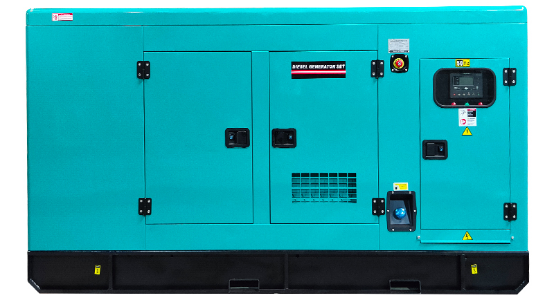
An outage at a bank branch happens without warning, often outside business hours, and nobody should depend on a guard pulling a recoil starter. Every financial installation should specify an auto-start diesel generator with an Automatic Transfer Switch (ATS). When mains voltage fails, the controller cranks the engine, stabilizes output, and the ATS transfers the branch load — typically within 8–12 seconds, comfortably inside UPS bridge time.
For ATM kiosks and unmanned self-service lobbies, telemetry is not optional — it is the only way to know a unit failed to start before customers find out. Longhong fits intelligent AMF controllers as standard across its automatic models, and the 64kW auto-start generator page lists the typical control configuration.
Bank branches sit in commercial and residential districts where daytime noise ordinances apply. A canopy diesel generator in a super-silent enclosure runs at 65–75 dB(A) at 7 meters — quiet enough for a rear courtyard or dedicated plant room adjacent to occupied space. Canopy units are also the easiest to install: they arrive as a single weatherproof package on the base frame with integral fuel tank, needing only a foundation pad, exhaust penetration and cabling. Longhong's full silent range — from the 10-14kW compact silent generator for small kiosks up to 100kW canopy units — follows the same installation logic, which simplifies multi-branch rollouts.
A bank's regional operations center, cash processing facility or data room justifies larger, weatherproof and more secure plant: this is where containerized diesel generators earn their place. A 20ft containerized genset delivers weather protection, acoustic treatment, larger integral fuel tanks, improved security against tampering and room for maintenance access — attributes that matter when the machine supports an entire district's ATM clearing operations. Our parallel generator guide covers how larger financial data facilities combine multiple containerized sets for N+1 redundancy.
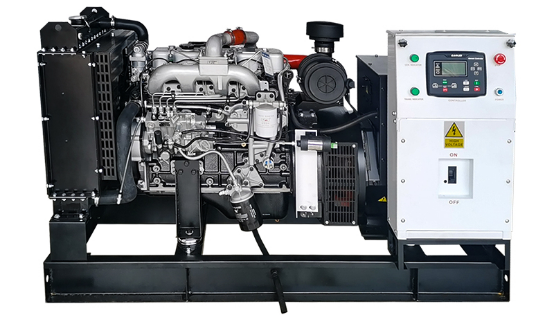
An open frame diesel generator is cheaper but noisy. It is appropriate for a bank only inside a properly soundproofed basement or rooftop plant room, and its lower cost rarely survives the acoustic construction budget. Most financial buyers end up choosing canopy for this reason.
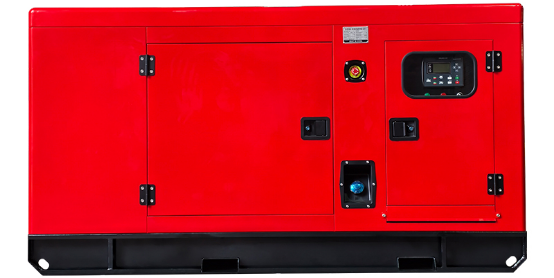
Define the design outage scenario per branch: 2–4 hours for urban grid-supplied branches, 8–12 hours or more where load shedding is routine. A genset consumes roughly 0.25–0.30 liters per kWh produced; a 50 kVA unit at 70% load burns around 8–10 L/h. Matching base-frame tank capacity with an external day tank — and a refueling contract — turns runtime from a guess into a plan. Our fuel consumption guide includes the full calculation method and cost tables.
Diesel stored for months degrades: water condensation, microbial growth and sediment clog filters exactly when the machine is needed. Banks should schedule fuel polishing or replacement every 12 months, use biocide in hot climates, and keep tanks at least 90% full to limit condensation. Longhong ships gensets with fuel system priming instructions and pre-delivery load test reports so the first real start is not the first test.
Weekly no-load or monthly on-load test runs, quarterly ATS transfer tests, and an annual load-bank test keep the system provably ready. Regulators increasingly accept only documented test logs — which is another reason the controller's event log matters. Keep consumables (filters, coolant, belts) on site; a genset down for a week waiting for a filter is as bad as no genset.
Stand-alone ATM kiosks and rural microfinance outlets need modest power — typically 5–10 kW — but absolute dependability. Compact silent units such as the 20kW silent diesel generator and the 24kW silent diesel generator are frequently deployed beside ATM cabins in our export markets, running automatically through evening outages while the canopy keeps residential neighbors comfortable. The 16kW compact silent genset covers single-kiosk sites where space is tight.
Some bank networks operate a pooled mobile reserve: a mobile trailer diesel generator that can be towed to any branch or ATM site during an extended outage or planned utility maintenance. Trailer-mounted canopy sets in the 20–50kW range are ideal — road-legal, weatherproof, and able to back up several sites per week. Site-to-site flexibility often beats buying a large fixed unit for every low-traffic location.
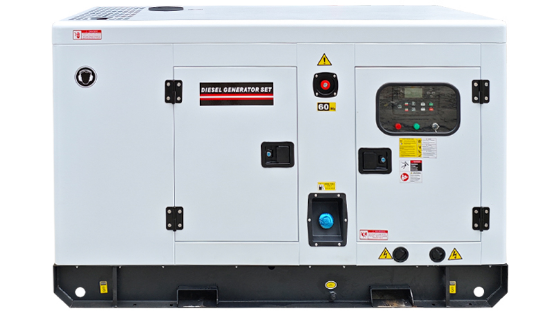
China supplies a large share of the world's diesel gensets, and the factory-direct route offers strong value — if you verify the right things before wiring money.
Buying direct from a China diesel generator manufacturer typically saves 25–40% versus reseller channels, and with a factory like Guangdong Longhong you deal with the source that assembles, tests and supports the machine. With 200+ units in permanent stock, standard ratings ship fast — important when a branch rollout has a fixed opening date.
A bank branch is judged by its ability to stay open — and power is the foundation of that promise. The formula is straightforward: size the diesel generator set for real motor-starting loads, choose an auto-start model with AMF and telemetry, wrap it in a silent canopy that respects urban noise rules, plan fuel for the design outage, and buy from a factory that proves every unit with load testing and stands behind it with parts and warranty. Institutions that follow this discipline turn outages from customer-facing failures into uneventful minutes of automatic switchover.
Ready to specify backup power for your branch network? Browse the diesel generator product range, review our company profile, or contact Longhong Power for a sizing consultation and factory-direct quotation.


