

 English
 العربية
 Español
 Русский
Industry News
Industry News

A dinner rush is the worst possible moment for a power outage. Within minutes, walk-in coolers start warming, fryers and griddles go cold, POS terminals go dark, and a fully booked dining room turns into a refund queue. For a mid-size restaurant, a two-hour outage on a Friday night can easily destroy more value than a complete diesel generator set costs. This guide explains, from a restaurant owner's and kitchen operator's perspective, how to assess loads, size a standby diesel generator, choose between single-phase and three-phase, control noise in dense urban locations, and buy confidently from a China diesel generator manufacturer.
Restaurants combine three risk profiles that few other small businesses share at once: perishable inventory, time-critical cooking operations, and revenue concentrated in short peak windows. Refrigeration alone makes the case. A filled walk-in cooler holds food safely for only a few hours without power, and a freezer's window is not much longer once doors keep opening during service. Throw out a weekend's worth of meat, seafood and dairy and you may lose more than the generator price in a single event.
Then there is the service itself. Gas cooking still needs electricity for ignition, controls, exhaust fans and make-up air. Electric kitchens — increasingly common with induction ranges — stop completely without power. Add POS systems, payment terminals, reservation software, lighting, HVAC and music, and the modern restaurant is fully electricity-dependent. Finally, outages are not random in their damage: they cluster around storms and grid faults, which is exactly when neighborhoods dine out less and margins are already under pressure. A properly configured emergency diesel generator with auto-start removes the dependence on staff being present and competent with a manual start-up sequence at 7 p.m. on a Saturday.
Operators who already run standby power report a further benefit: the generator also covers smaller, more frequent disturbances — voltage sags and momentary dips that reset kitchen equipment and POS terminals. An 64kW automatic diesel generator with AMF control starts and transfers in seconds, fast enough that refrigeration controllers and POS systems ride through without intervention.
Before sizing anything, divide the restaurant's loads into three tiers. This is the single most useful exercise in the whole project, because it determines whether you need a modest unit or an oversized one.
Emergency lighting, exit signs, fire alarm panels and, where required, fire pumps and smoke extraction fans. These loads are usually small — often under 3–5 kW — but they are non-negotiable and must transfer automatically.
This tier is the heart of restaurant backup: walk-in coolers and freezers, blast chillers, ice machines, exhaust hoods and make-up air fans, water heaters, POS and network equipment, and essential kitchen cooking circuits. Compressors dominate this tier, and compressor motors draw 3–6 times their running current at start-up — a fact that shapes generator sizing more than any other factor in a restaurant.
Decorative lighting, music, some HVAC zones, dishwashing during the outage. These can be connected through a secondary contactor that the controller sheds automatically when the generator nears capacity, protecting Tier 2 loads from overload trips.
A practical approach used by many operators: wire Tier 1 and Tier 2 to a dedicated emergency distribution board fed through an automatic transfer switch, and leave Tier 3 on the utility feed. During an outage the restaurant continues serving a reduced menu under full lighting with cold storage, POS and hoods live — not closed.
Restaurant sizing fails in a predictable way: owners add up nameplate watts, buy a generator that matches the total, and then discover the unit stalls when three compressors and the exhaust fan start simultaneously. Correct sizing accounts for motor starting.
Consider a typical full-service restaurant with the following Tier 1 + Tier 2 loads:
Running total: about 24.6 kW. Now apply motor starting. The largest simultaneous start is the freezer compressor (3.0 kW running, roughly 9–15 kW momentary at start). With staggered starts or soft starters on the compressors, a sizing margin of about 1.4–1.5 on the running total is realistic: 24.6 × 1.45 ≈ 35.7 kW, which lands in the 40 kW class. Where three compressors may start together without staging, step up one class further to a 64 kW unit for headroom and future kitchen expansion. For small cafés, bakeries and quick-service outlets with one cooler and basic equipment, a compact 32kW silent diesel generator or even a 24kW silent diesel generator covers the same Tier 1 + Tier 2 logic at lower cost.
One discipline matters more than any chart: run the numbers for your equipment nameplates, and prefer staged compressor starting (cheap timer or soft-starter modules) over buying a bigger generator. Money spent on starters usually buys more resilience per dollar than money spent on extra kVA.
Most standalone restaurants on neighborhood distribution are served single-phase (230 V in much of the world, 120/240 V in North America), and most kitchen equipment up to about 5 kW per appliance is single-phase. For these sites a single-phase diesel generator in the 20–40 kW class is the correct, simplest choice.
Choose three-phase when any of the following apply: the building supply is three-phase; large rooftop HVAC or a three-phase fire pump must be backed; the site is inside a hotel, mall or food court where the landlord's emergency board is three-phase; or the restaurant shares a generator with neighboring units. Three-phase gensets in the 64–100 kW range are standard for these multi-tenant and large-format kitchens. A mid-size flagship restaurant or a hotel banquet kitchen typically ends up with an 80kW silent diesel generator or a 100kW diesel generator to carry cooling, cooking and HVAC together.
A useful export note for buyers sourcing from China: reputable factories supply both configurations from the same engine platforms, with 50 Hz and 60 Hz windings and reconnectable 12-lead alternators — confirm voltage and frequency at order stage, not after delivery.
Restaurants are, by definition, in noise-sensitive locations — often beside residential upper floors, with patio seating closer to the generator pad than to the kitchen. Noise is therefore a selection criterion, not an afterthought.
The default answer is a canopy diesel generator (silent type). A quality super-silent canopy holds the sound pressure level to roughly 65–70 dB(A) at 7 meters — comparable to a busy kitchen itself — through acoustic insulation, baffled airflow, and anti-vibration mounts. Placement does the rest: locate the unit in a service alley or rear yard, orient the exhaust away from seating and bedroom windows, and where regulations are strict, add a barrier wall or a louvered acoustic fence. Indoor installation in a basement plant room is also workable when ventilation and exhaust can be ducted — many urban restaurants do exactly this with a compact silent unit.
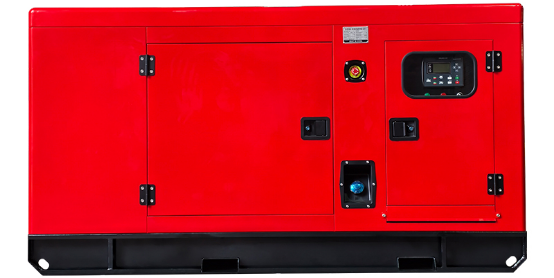
An 80kW silent canopy genset — the typical class for a flagship restaurant or banquet kitchen.
Open frame generators cost less but produce 90+ dB(A) and belong only where the unit sits far from any neighbor — for example a roadside restaurant on its own lot with a rear service compound. Even then, a canopy usually repays its premium in permits and neighbor relations within the first year.
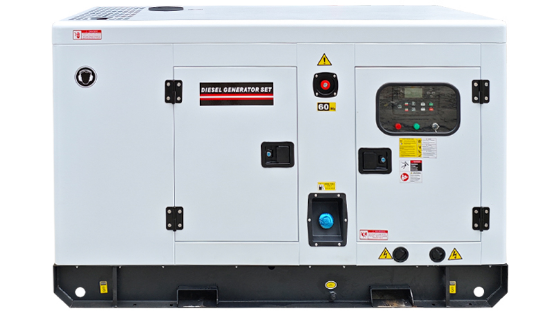
A 32kW silent unit covers cafés and mid-size restaurants with cooler, hood and POS loads.
Outages during service leave no time for manual starting, and outages overnight — when freezers are unattended — are the expensive ones. Specify an AMF (automatic mains failure) controller so the genset starts, stabilizes, and transfers through the ATS within about 10 seconds, then transfers back and cools down when utility power returns. Modern controllers also log events and run hours, which doubles as proof for insurers and food-safety auditors that cold chain was maintained.
Diesel gensets consume roughly 0.25–0.30 liters per kWh produced at realistic load factors. A 40 kW unit running a night-long outage at ~70% load uses around 7–8 liters per hour — call it 90–100 liters for a 12-hour outage. A base tank often holds 8–12 hours; extending to 24–48 hours of autonomy means an external day tank with proper containment. Restaurants that already receive fuel deliveries for other equipment can simply add the generator to the same contract; others should verify a local delivery service can respond within 24 hours. Diesel's storability — years, not months, with basic care — is precisely why it beats gasoline for power outage backup power generator duty in kitchens.
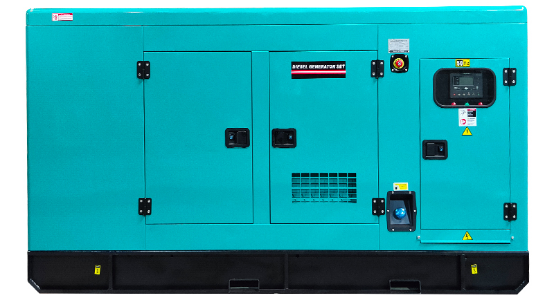
A 100kW genset carries cooling, cooking and HVAC for large-format restaurants and food courts.
A generator that never runs is a liability wearing a warranty. The industry-standard rhythm — a weekly no-load or light-load exercise of 15–30 minutes plus a monthly transfer test under real load — takes under an hour per month and is best scheduled for a weekday morning, not before dinner service. Verify that compressors cycle, the hood fan starts, and POS circuits hold.
China remains the value center of the global genset market, and the difference between a good purchase and a regret is disciplined sourcing. Check these points before wiring any deposit:
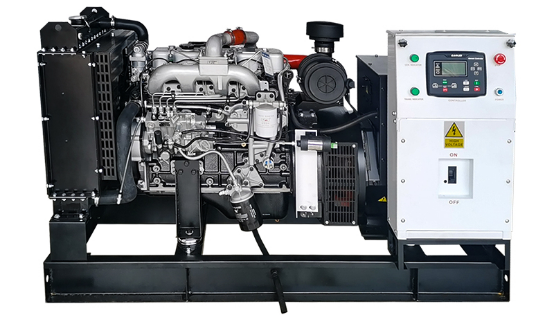
Open frame sets suit rear-compound installations; canopy models fit urban dining districts.
For a complete overview of generator types and company capabilities, start from the Longhong Power homepage, where you can also request a quotation matched to your kitchen's load list.
A restaurant generator project reduces to four decisions: classify your loads into safety, food-revenue and sheddable tiers; size with motor-starting margins rather than nameplate totals; specify a silent canopy with AMF auto-start; and plan fuel autonomy for at least one full service day. Do these well and a mid-size restaurant lands in the 24–40 kW class, a flagship or banquet kitchen in the 64–100 kW class. Buy from a certified China manufacturer that load-tests every set and supports parts long-term, and the system will protect more value in its first serious outage than it cost to install.
About Guangdong Longhong Electromechanical Equipment Co., Ltd.
Founded in 2010 in Guangdong, China, Longhong Power manufactures diesel generator sets from 3KVA to 3000KVA powered by Cummins, Weichai, Yuchai, Perkins, Volvo and Yunnei engines. The product range covers open frame, silent/canopy, trailer and containerized types, all backed by CE and ISO certification and a permanent stock of 200+ units. Sets have been exported to Cambodia, Vietnam, Myanmar, Tanzania, Libya and more. Learn more at www.longhongpower.com.


