

 English
 العربية
 Español
 Русский
Industry News
Industry News

One of the most expensive mistakes an international buyer can make is ordering a diesel generator set built for the wrong frequency. A 60Hz genset shipped to a 50Hz country will run every motor and compressor at 17% overspeed, while a 50Hz unit in a 60Hz market delivers 17% less power than the nameplate suggests. This guide explains how frequency and voltage work in a diesel power generator, which configurations each region uses, how manufacturers adapt a single engine platform to both standards, and exactly what to confirm with your China diesel generator manufacturer before signing the contract.
Frequency — 50 or 60 hertz — is determined by the alternator's rotational speed. At 50Hz a four-pole alternator spins at 1,500 rpm; at 60Hz it spins at 1,800 rpm. Voltage, by contrast, is adjusted through the alternator windings and the automatic voltage regulator (AVR). This asymmetry has a critical consequence: you cannot convert frequency after delivery. Voltage can be matched with transformers or re-terminated windings, but a genset built at the wrong frequency is permanently wrong for the grid.
First, it governs every motor connected to the generator. Induction motors turn at a speed locked to supply frequency — pumps, fans, refrigeration compressors, and machine tools all speed up or slow down by 17% if the frequency does not match. Second, it governs the engine's operating point: the governor holds the diesel engine at 1,500 or 1,800 rpm, which changes fuel consumption, noise, and wear characteristics. Third, it governs the effective power output, as the next section explains.
Buyers sourcing from a diesel genset factory should therefore treat frequency as the first specification on any enquiry — before kVA rating, before enclosure type, before price.
Most of the world runs 50Hz: Europe, the United Kingdom, Africa, the Middle East, most of Asia, Australia, and South America's largest economies. North America, parts of Central America, Saudi Arabia (60Hz alongside 50Hz zones), South Korea, Taiwan, and the Philippines run 60Hz. Japan is split between both.
| Region | Frequency | Typical Mains Voltage (3-Phase) |
|---|---|---|
| UK & Ireland | 50Hz | 400V / 230V |
| Continental Europe | 50Hz | 400V / 230V |
| Africa (most countries) | 50Hz | 380–415V / 220–240V |
| Middle East (most countries) | 50Hz | 380–400V / 220–230V |
| North America | 60Hz | 480V / 277V or 208V / 120V |
| Philippines | 60Hz | 380–400V / 220V |
| South Korea / Taiwan | 60Hz | 380V / 220V |
For export markets, a diesel power generator supplier with 20+ years of export experience will confirm the destination grid during specification review — not after production. Longhong has shipped to Tanzania, Libya, Cambodia, Vietnam, Myanmar and other markets spanning both 50Hz and mixed-voltage territories, so grid configuration is checked on every export order.
Alternator power output is roughly proportional to rotational speed. This produces a simple but frequently ignored rule:
A genset converted from 60Hz to 50Hz delivers about 83% of its 60Hz rating. A 100kW frame running at 60Hz becomes an 83kW unit at 50Hz. Buyers who skip this step routinely order undersized equipment — an 80kW silent generator specified for a 60Hz site will only power 66kW of load if it is operated at 50Hz.
When you size a standby diesel generator, always size against the rating at your frequency. If your datasheets come from a US supplier quoting 60Hz ratings and your site is 50Hz, apply the 0.83 factor before comparing with your load calculation. Reputable manufacturers publish both figures; if a quotation shows only one, ask which frequency it applies to.
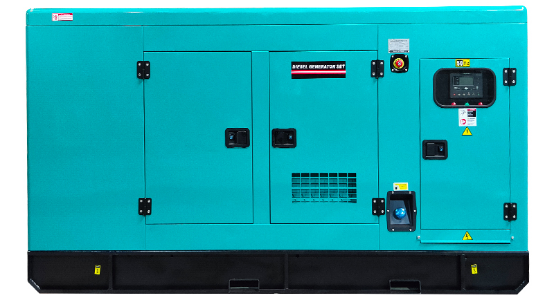
Most industrial and commercial diesel genset orders are three-phase, which suits motors, three-phase distribution boards, and balanced loads. A single-phase diesel generator is appropriate for homes, small shops, telecom cabinets and irrigation pumps. Many export models offer both: a 12-lead alternator can be reconnected in the field between series-star and parallel-star, letting one machine serve 380/220V and 400/230V territories.
Beyond frequency, tell your supplier the exact mains voltage so the AVR and terminal connections arrive correct. Typical export requests include:
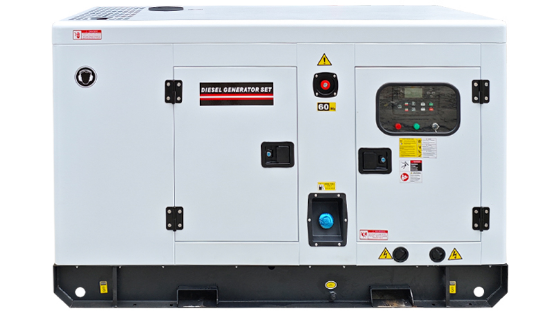
The diesel engine itself is not frequency-specific — the governing system is. For 50Hz the electronic governor holds 1,500 rpm; for 60Hz, 1,800 rpm. Because a higher speed means more air and fuel per second, the same engine produces more power at 60Hz, which is exactly why the rating changes. Cooling fans and charge-air piping are also rated for the matching speed, so a proper conversion swaps the radiator and fan assembly, not just a setting.
Alternator winding configuration and the AVR sense-point define voltage. A quality export alternator offers multiple reconnectable windings and a wide AVR sensing range (typically 170–265V or 340–520V depending on connection). The manufacturer selects the winding connection, sets the AVR, labels the terminal box with the destination voltage, and tests the complete power generator under load at the ordered frequency before it leaves the factory.
Before shipment, insist on a load-bank test at the exact ordered frequency and voltage: 25%, 50%, 75% and 100% load steps, recorded voltage and frequency stability, and a full-load shutdown test. Any ISO and CE certified diesel generator factory should provide these test reports with the delivery documents — if a supplier cannot produce them, treat it as a red flag on quality control generally.
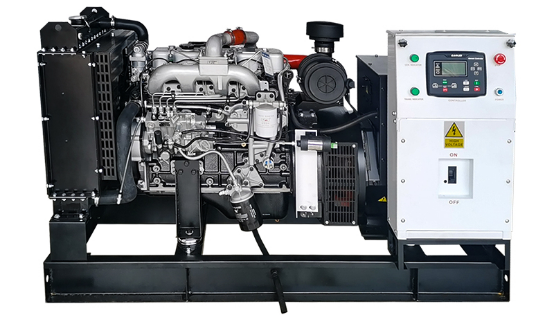
Consider a textile workshop in a 50Hz country with a calculated load of 95kW, including three 15kW motors started across-the-line. The buyer intends a three-phase diesel generator at 380V/220V.
DOL motor starting needs roughly 1.5–2× running power headroom on the genset for voltage dip control. The largest motor adds transient demand; the practical peak works out near 130kW of genset capacity.
Because the site is 50Hz, the buyer must order a unit rated at 50Hz. If a datasheet quotes a 60Hz rating of 150kW, the 50Hz rating is about 125kW — marginal. The correct move is to step up one frame: a 150kW-class unit rated at 50Hz, such as the 100kW industrial diesel generator family extended to the next frame in the same catalogue, gives clean margin at 50Hz.
Specify 380V/220V, 50Hz, three-phase, 12-lead reconnectable alternator, and 230V single-phase outlets if site tools need them. This is the standard configuration on units like the 40kW export diesel generator and its larger siblings, and it is confirmed line-by-line in the order sheet before production.
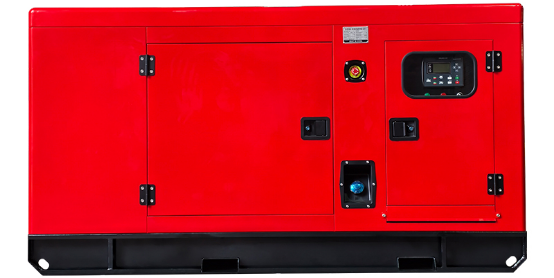
The three recurring errors are ordering by 60Hz catalogue numbers for a 50Hz site, accepting a quotation without a stated frequency, and skipping the load-bank report. Each is avoidable with a one-line question. A brief look at a completed 100KVA Cummins export project delivered to Tanzania shows what a correct export package looks like — matched frequency, matched voltage, and documented testing.
Frequency is not a detail; it is the foundation of every other specification on a diesel generator set. Get it right and the machine behaves exactly as the nameplate promises; get it wrong and you have bought a permanent 17% problem. Anchor every enquiry to three facts — your grid frequency, your exact voltage, and the rating basis at that frequency — then demand a factory load test as proof.
Guangdong Longhong Electromechanical Equipment Co., Ltd., established in 2010 with 20+ years of engineering experience, builds silent, open frame, trailer and containerized gensets from 3KVA to 3000KVA powered by Cummins, Weichai, Yuchai, Perkins, Volvo and Yunnei engines — all configurable to 50Hz or 60Hz and exported worldwide from 200+ units of permanent stock. Contact our team today for a frequency-correct quotation for your market.


