

 English
 العربية
 Español
 Русский
Industry News
Industry News

Every facility manager, purchasing officer, and project engineer eventually has to buy a diesel generator set — yet many compare price tags and kVA ratings without understanding what actually happens inside the machine. Knowing how a diesel genset works is not academic: it is what allows you to judge whether a supplier's alternator grade, engine brand, and control system deserve your money, and why two generators with identical nameplates can perform completely differently after six months. This guide explains the working principle of a diesel power generator, walks through each major component, and shows how that knowledge translates into smarter buying decisions in 2026.
A diesel generator is an energy conversion machine. Chemical energy stored in diesel fuel is burned inside an engine to produce rotational mechanical power, and that rotation spins an alternator, which converts mechanical energy into electrical energy. Three subsystems keep this conversion continuous: the fuel system feeds the engine, the cooling and lubrication systems protect it, and the control system supervises everything from cranking to shutdown.
Industrial diesel generator sets use four-stroke engines operating on the compression-ignition principle. During the intake stroke, the piston draws air alone into the cylinder — no fuel yet. During the compression stroke, the piston squeezes that air to roughly 16:1 or 17:1 compression ratio, heating it to over 500°C. Near top dead center, the fuel injection system sprays a precisely metered dose of diesel into the superheated air; the fuel ignites on contact without any spark plug. The expanding combustion gases force the piston down in the power stroke — this is where usable work is produced. Finally, the exhaust stroke expels burnt gases, and the cycle repeats hundreds of times per minute.
This compression-ignition design is exactly why diesel engines dominate the standby diesel generator and prime power markets. Compression ignition engines tolerate heavy, sustained loads, achieve thermal efficiency of 35–45% (far above gasoline engines), and run for tens of thousands of hours when properly maintained. That is why data centers, hospitals, mines, and construction sites around the world standardize on diesel.
The engine's rotating crankshaft is coupled — directly, through a flywheel housing, or via a flexible coupling — to the alternator rotor. The rotor carries a DC-excited magnetic field. As it spins inside the stationary stator windings, the rotating magnetic field induces an alternating voltage across the stator terminals: Faraday's law of electromagnetic induction in action. The output is three-phase AC on industrial sets (400V/50Hz, 415V/50Hz, or 480V/60Hz depending on the destination country) and single-phase AC on smaller single-phase diesel generator models used for homes, shops, and small farms.
Guangdong Longhong Electromechanical Equipment Co., Ltd. builds diesel generator sets from 3KVA to 3000KVA on exactly this architecture — a genuine Cummins, Weichai, Yuchai, Perkins, Volvo, or Yunnei engine coupled to a brushless alternator, supervised by an electronic control module. The same physical principle scales from a 10kW compact unit to a megawatt-class diesel power plant.
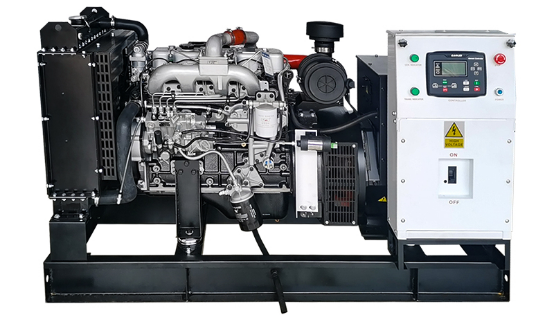
Open frame diesel generator set — with the canopy removed, you can see the engine, alternator, and base fuel tank that make up the core conversion chain.
A complete diesel genset is more than an engine with a dynamo bolted on. Seven subsystems must work together, and the quality of each one determines whether your power generator starts on the coldest night of the year or fails during the first real blackout.
The engine is the heart and typically 50–60% of the genset's cost. Reputable manufacturers worldwide source engines from established brands — Cummins, Perkins, and Volvo for international specifications; Weichai, Yuchai, and Yunnei for proven Chinese platforms — because engine brand determines parts availability for the next 20 years. When evaluating any China diesel generator manufacturer, confirm the engine is factory-new with a traceable serial number, not a refurbished or counterfeit unit. Engine ratings also differ by duty class: a standby-rated engine is optimized for emergency operation, while prime-rated engines are built for sustained daily loading.
The alternator converts rotation into electricity. Quality alternators (brushless design, class H insulation, copper windings rather than aluminum) maintain output under non-linear loads such as VFDs, UPS systems, and LED lighting banks. A critical but often overlooked component inside the alternator is the Automatic Voltage Regulator (AVR). The AVR continuously samples output voltage and adjusts the rotor's excitation current hundreds of times per second, holding voltage within ±1% even when loads switch abruptly. A cheap AVR is the single most common cause of "generator killed my equipment" complaints — voltage spikes from a failing AVR destroy computers, compressors, and medical devices.
The fuel system comprises the day tank (usually built into the base frame for 8–12 hours of operation), fuel filters and water separators, feed pumps, and the high-pressure injection hardware on the engine. Water and contamination in diesel are responsible for a large share of no-start and power-loss service calls, which is why serious buyers specify water separators and demand clean, polished fuel delivery before commissioning.
Radiator with belt-driven fan (or a heat-exchanger setup for marine and confined installations) keeps coolant near 85–95°C; the oil pump circulates lubricant to bearings, liners, and the turbocharger. Overheating and low oil pressure are the two most common protective shutdowns, and both trace back to maintenance discipline: coolant condition, radiator cleanliness, oil level, and filter change intervals.
The controller is the genset's brain. Modern digital modules (DSE, SmartGen, ComAp and equivalents) handle automatic start, crank cycles, warm-up, load transfer signals, protective shutdowns (over-speed, low oil pressure, high coolant temperature, over/under voltage), and telemetry via Modbus or GSM. On an auto-start diesel generator, the controller monitors mains power through an ATS (automatic transfer switch) and brings the set online within about 10 seconds of a grid failure — no human input required. The starting system itself is a heavy-duty battery bank and starter motor; batteries deserve daily attention because a flat battery renders the entire emergency diesel generator useless at the worst possible moment.
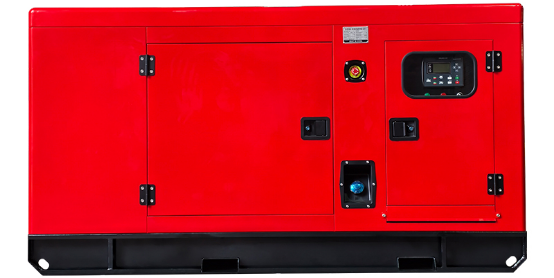
80kW silent diesel generator — the digital control module on the canopy panel supervises start-up, protection shutdowns, and ATS communication.
The base frame ties engine and alternator into one rigid, vibration-isolated unit and often integrates the fuel tank. Industrial silencers and, on enclosed models, a canopy diesel generator housing bring noise down to 65–75 dB(A) at 7 meters — a decisive specification for residential areas, hotels, schools, and urban construction sites. Exhaust systems must be sized correctly; an undersized silencer or crushed flex bellows raises back-pressure, which raises exhaust temperature and quietly shortens engine life.
The table below summarizes each subsystem and what to inspect when comparing suppliers:
| Component | Function | What to Check Before Buying |
|---|---|---|
| Diesel engine | Converts fuel to rotation | Genuine brand, serial number traceable, correct duty rating (standby/prime) |
| Alternator | Converts rotation to AC power | Brushless, copper windings, class H insulation, 2/3 pitch for non-linear loads |
| AVR | Holds voltage within ±1% | Digital AVR, tested voltage dip/recovery report |
| Fuel system | Stores, filters and injects diesel | Water separator, tank capacity vs required autonomy |
| Cooling & lubrication | Protects engine from heat and wear | Radiator sized for site ambient temperature; oil capacity and filter grade |
| Control panel | Automates start/stop and protection | Digital module brand, ATS compatibility, telemetry options |
| Base frame & canopy | Rigid mounting, noise control | Welded steel frame, 65–75 dB(A)@7m enclosure, anti-vibration mounts |
Output frequency is tied directly to engine speed by a fixed relationship: a 4-pole alternator produces 50 Hz at exactly 1,500 rpm, or 60 Hz at 1,800 rpm. The engine speed is regulated by the governor — mechanical on older units, electronic (and increasingly common) on modern gensets. When a large motor starts, load suddenly increases, engine speed dips, and the governor injects more fuel within milliseconds to restore 1,500/1,800 rpm. Frequency stability under step loads is one of the most revealing quality indicators: on a well-matched engine-alternator package, voltage dip stays within ISO 8528-5 limits and recovers in under two seconds. This is why honest manufacturers publish full-load test reports and welcome witnessed testing before shipment — the physics cannot be faked on a test bench.
The same working principle is packaged in different enclosures for different duty:
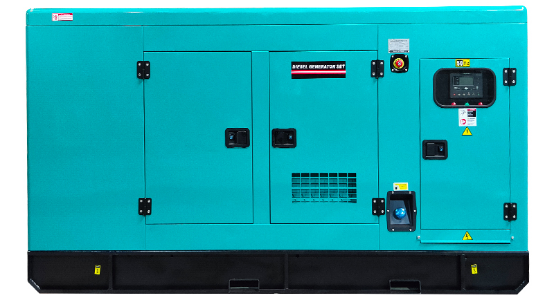
100kW silent canopy diesel generator — same engine-alternator principle as an open frame, wrapped in a sound-attenuated weatherproof enclosure.
Longhong supplies all three formats across the 3KVA–3000KVA range; the conversion principle never changes, only the packaging around it.
Buyers are often confused when one supplier quotes 100 kVA and another quotes 80 kW for a similar machine. The relationship is fixed: for three-phase sets, kW = kVA × 0.8 (the standard power factor). The alternator's kVA defines the total apparent power it can carry; the kW rating reflects the engine's ability to sustain the real-power portion. A genset can be alternator-limited (low kVA) or engine-limited (low kW) depending on the pairing — a manufacturer that matches both correctly across its range, rather than pairing whatever alternator is cheapest that week, delivers sets that hold voltage and frequency for years. This is also why a reputable diesel generator factory publishes both ratings together with duty class (standby vs prime), ambient derating data, and test reports rather than a single headline number.
Understanding the components turns specification sheets into a quality filter. When evaluating offers from any China diesel generator manufacturer or power generator supplier, use the working principle as your audit framework:
Longhong's certification portfolio covers CE and ISO 9001, and the factory keeps 200+ completed units in permanent stock — from 10–14kW compact silent sets for shops and homes to 100kW industrial diesel generators for factories and commercial buildings.
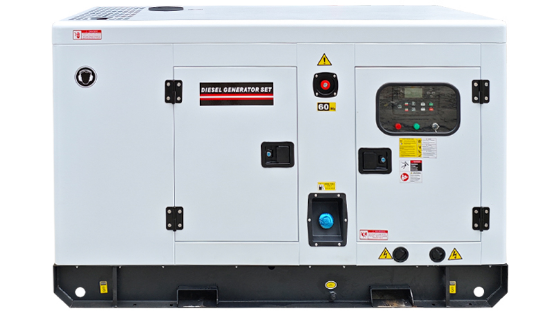
32kW silent diesel generator built for export — genuine engine, brushless alternator with digital AVR, and full-load tested before dispatch.
The same engineering discipline is visible in real projects: Longhong's 100KVA Cummins export installation in Tanzania and the 400KW/500KVA Yuchai silent generator project both follow the component standards described in this guide — genuine engines, matched alternators, digital control, and witnessed load testing before shipping.
A diesel generator is a chain of conversions: diesel fuel becomes combustion, combustion becomes rotation, rotation becomes alternating current, and a set of supervision systems keeps the whole chain stable within ±1% voltage and a fraction of a hertz. Every component in that chain — engine, alternator, AVR, governor, fuel system, cooling, controller, and enclosure — is a decision point that separates a genset which starts faithfully for 20 years from one that fails during its first real emergency. Buyers who understand the working principle negotiate better, test smarter, and end up with machines their facilities can actually depend on.
Whether you are specifying a portable diesel generator for a small workshop, a three-phase standby set for a hotel, or containerized prime power for an industrial site, start from the components — not the brochure headline. Browse the Longhong product catalog to see engine-alternator configurations across the full 3KVA–3000KVA range, or contact our engineering team for a specification review before you commit to a supplier.


