

 English
 العربية
 Español
 Русский
Industry News
Industry News

Small workshops, auto repair garages, metal fabrication units and light assembly plants cannot afford downtime. A single power outage can spoil a batch, idle CNC operators, or trap vehicles on a lift. A reliable diesel generator set keeps compressors, welders, paint booths and lighting circuits running until grid power returns. This guide explains how to choose, size and install a power generator for small industrial sites, with practical advice for buyers sourcing from a China diesel generator manufacturer.
Unlike offices, workshops run motor loads. Air compressors, lathes, milling machines, welding sets, hydraulic lifts and dust extractors all draw high inrush current when they start. A brief outage can cause more than inconvenience: half-cut parts ruin stock, paint curing ovens cool unevenly, and computer-controlled machines lose reference positions.
A standby diesel generator sized for your critical loads restores power within seconds when paired with an automatic transfer switch (ATS). For sites without grid connection or with unreliable supply, a portable diesel generator or skid-mounted unit can serve as the primary power generator during working hours.
Diesel engines are preferred over gasoline for workshop duty because they deliver:
Guangdong Longhong Electromechanical Equipment Co., Ltd. builds diesel generator sets from 3KVA to 3000KVA, including compact 10-14kW, 16kW, 20kW, 24kW and 30kW units that fit small workshop budgets and footprints.
Accurate load assessment prevents two common mistakes: buying an undersized generator that trips on motor starting, or overspending on an oversized unit that runs inefficiently and "wet stacks."
Walk the floor and record the rated power of every machine, light, fan, heater and socket circuit. Note whether each load is resistive (heaters, incandescent lights) or inductive (motors, transformers, welders, compressors). Inductive loads need a surge multiplier during start-up.
Not everything must run during an outage. Critical loads might include security lights, fire pumps, emergency ventilation, CNC controller circuits, refrigeration and one compressor. Non-essential loads such as decorative lighting, coffee machines and non-urgent welding can wait.
A direct-on-line (DOL) motor can draw 5-7 times its running current for 1-3 seconds. If your largest motor is a 7.5kW compressor, the generator must supply at least 37-50kVA of momentary surge. Soft starters or variable frequency drives reduce this multiplier to 2-3x, lowering the generator size and cost.
Not all machines run at full power simultaneously. Apply a diversity factor of 0.6-0.8 based on your work pattern. Then add 15-20% spare capacity for future tools. A workshop that calculates 32kW of effective load should target a 40-50kVA generator, not a 32kVA unit.
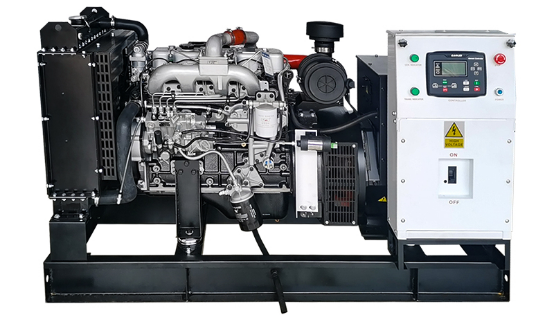
Generator sizing is not just about kilowatts. You must also consider kVA, power factor, altitude derating and ambient temperature. Here is a worked example for a small metal workshop.
A workshop lists the following critical loads: two 5kW grinders, one 7.5kW air compressor (DOL), one 4kW drill press, one 3kW dust extractor, 8kW of LED and task lighting, 6kW of socket circuits, and 5kW of heating. Total connected load is 43.5kW. Applying a diversity factor of 0.75 gives an effective load of 32.6kW.
The compressor starts direct-on-line. Its 7.5kW motor needs roughly 6x starting current, so the generator must support a 45kVA surge. A 64kW automatic diesel generator or an 80kW silent diesel generator provides comfortable headroom, keeps voltage dip below 15%, and leaves room for a second machine.
| Workshop Type | Typical Critical Load | Recommended Rating |
|---|---|---|
| Small auto garage | 10-15kW | 16-24kW diesel genset |
| Carpentry / furniture workshop | 20-30kW | 30-40kVA power generator |
| Metal fabrication shop | 35-55kW | 64-80kVA diesel power generator |
| Light assembly plant | 60-100kW | 100-125kVA standby diesel generator |
Diesel engines lose power at high altitude and high ambient temperature. Above 1000m, derate by roughly 3-4% per 300m. Above 40°C ambient, derate by another 2-3%. If your workshop is in a hot or high region, choose the next size up or select an engine with a larger displacement.
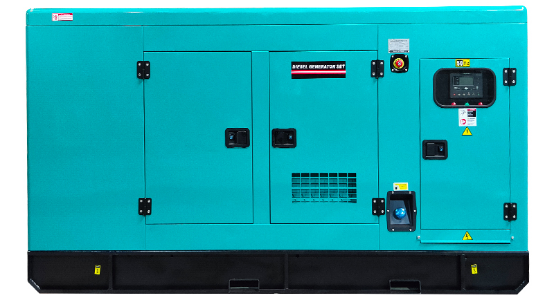
Workshops often mix single-phase hand tools and lighting with three-phase machinery. Choosing the right output configuration avoids rewiring costs and unbalanced loads.
A single-phase diesel generator is suitable for small garages, mobile service vans, rural workshops and sites with only 220-240V loads. The 10-14kW silent diesel generator and 24kW silent diesel generator are popular for single-phase backup where three-phase machines are not used.
A three-phase diesel generator is the right choice when motors exceed 5kW, or when the site already has a three-phase distribution board. Three-phase units deliver smoother motor starting, better voltage stability and balanced loading across windings. Most 32kW and larger sets from Longhong are three-phase as standard.
If your workshop has both, specify a generator with dual-voltage capability (220/380V or 120/208V) and a properly sized neutral. Load each phase as evenly as possible. Never connect all single-phase loads to one phase while running three-phase motors on the others; unbalance can overheat the alternator and trip protection.
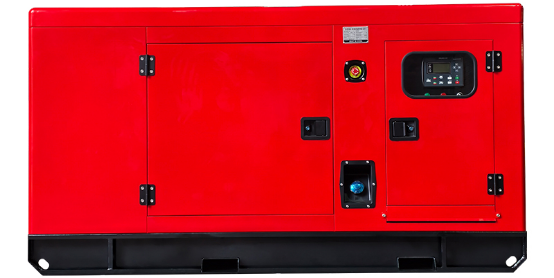
Workshops are noisy, but neighbouring offices, homes or classrooms may not be. A canopy diesel generator reduces noise to 65-75 dB(A) at 7 metres, roughly the level of a vacuum cleaner. This makes it possible to place the set closer to buildings without complaints.
Open frame generators are cheaper and easier to service, but they emit 85-95 dB(A). Use them only inside dedicated plant rooms with acoustic treatment, or in remote yards where noise is not regulated. For shared industrial parks or residential-adjacent sites, choose a 32kW silent diesel generator or a larger canopy unit.
If you install the generator indoors, the room must provide:
Even small diesel generators create vibration. Mount the set on a concrete inertia pad or anti-vibration rails. Keep fuel lines, exhaust and electrical conduits flexible so vibration does not crack connections over time.
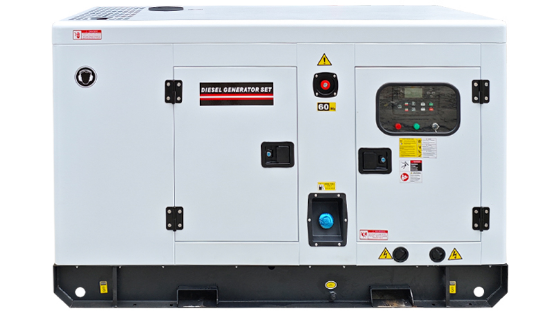
Workshops usually need enough fuel autonomy to finish a shift or safely shut down equipment. A 4-8 hour runtime is common for standby duty; 24 hours or more is recommended where outages are frequent or prolonged.
Modern diesel engines consume roughly 0.2-0.25 litres of fuel per kWh at 75-80% load. A 50kW generator running at 40kW will use about 8-10 litres per hour. At 50% load, consumption drops to 5-6 litres per hour. Buying a generator that normally runs at 50-80% load gives the best fuel economy and avoids wet stacking.
Size the tank for your target runtime plus a safety margin. For an 8-hour runtime at 8 L/h, you need at least 70 litres, plus 10% expansion. Use clean diesel with low sulphur and water content. Install a water separator and consider a fuel polishing system if the set runs rarely.
Garages in cold climates need block heaters and winter-grade diesel. A coolant heater keeps the engine warm so it starts immediately during a winter outage. Specify this option when ordering; it is far cheaper than adding it later.
China is a major source of cost-competitive industrial emergency diesel generator sets, but not all suppliers are equal. Use this checklist before placing an order.
Ask for the exact engine model number, not just the brand. Cummins, Weichai, Yuchai, Perkins, Volvo and Yunnei are all established names, but each has multiple series. Match the engine to your intended duty: standby, prime or continuous. The alternator should be brushless with AVR and class H insulation.
CE and ISO certification are baseline requirements for export to Europe and many other regions. Ask for a factory test report showing voltage regulation, frequency stability and load-step response. View Longhong's qualifications to see the certification portfolio.
A workshop generator should include an AMF (automatic mains failure) controller or at least manual/auto start capability. If you need automatic transfer, confirm that the ATS is rated for your maximum fault current and matches the generator controller protocol.
Check the steel gauge of the canopy, the quality of the exhaust silencer, the wiring looms and the control panel layout. Ask which spare parts are stocked locally and how the supplier handles warranty claims. A diesel generator factory with 20+ years of experience and 200+ units in permanent stock can usually deliver faster support.
Make sure the generator is configured for your local voltage and frequency: 50Hz or 60Hz, 220/380V, 230/400V, or 120/208V. Verify shipping terms, Incoterms, and whether the supplier provides a wiring diagram, manuals and commissioning support. A well-packed set arrives ready for local electricians to connect.
A properly sized diesel generator set turns a workshop power outage from a crisis into a brief interruption. Start by listing your critical loads, applying motor-starting multipliers, and choosing between single-phase and three-phase output. Match the enclosure to your noise environment, plan fuel autonomy for your typical outage length, and buy from a China diesel generator manufacturer that can prove engine authenticity, certification and after-sales support.
Guangdong Longhong Electromechanical Equipment Co., Ltd. has supplied power generator solutions to workshops, factories, construction sites, schools, hospitals and telecom projects since 2010. With engine options from Cummins, Weichai, Yuchai, Perkins, Volvo and Yunnei, and ratings from 3KVA to 3000KVA, Longhong can configure the right standby diesel generator or emergency diesel generator for your small industrial site.
About Guangdong Longhong Electromechanical Equipment Co., Ltd.
Established in 2010 in Guangdong, China, Longhong is a CE and ISO certified diesel generator manufacturer with more than 20 years of industry experience. The company builds open frame, silent canopy, trailer and containerized generator sets from 3KVA to 3000KVA, maintains over 200 units in permanent stock, and exports to Cambodia, Vietnam, Myanmar, Tanzania, Libya and other markets worldwide.


