

 English
 العربية
 Español
 Русский
Industry News
Industry News

Most diesel generator failures are not mysterious. In two decades of manufacturing and servicing diesel generator sets — from 10–14kW silent units backing up shops and homes to 500KVA installations at schools and factories — engineers see the same ten fault patterns again and again. The good news: most have recognizable symptoms, cheap fixes, and, better still, easy prevention. This guide walks facility managers, site supervisors, and owners through practical diagnosis of the ten most common diesel genset problems in 2026, so a small fault never becomes a full stoppage at the worst possible moment.
Troubleshooting an energized power generator can be lethal. Follow these rules every time:
With safety covered, here are the ten problems that account for the overwhelming majority of service calls on standby diesel generator and prime power sets alike.
Symptoms: silence or a weak click when the start command is given; dimming panel lights.
Cause: this is the most frequent failure of any emergency diesel generator, and it is almost always the battery — discharged by a failed charger, corroded terminals, sulfation from age, or parasitic drain from accessories left on. Starter solenoid or motor faults are the second suspect.
Fix: measure battery voltage (a 12V system should read 12.6V+ at rest, above 9.5V while cranking). Clean and tighten terminals, test the static charger's output, load-test the battery, and replace it if capacity has dropped below spec. Batteries are consumables: plan replacement every 2–3 years regardless of appearance.
Symptoms: healthy cranking speed, no firing, or fires briefly then dies.
Cause: fuel starvation or air in the fuel system. Empty tank (more common than anyone admits — verify the gauge against the actual level), closed fuel valve, clogged filters, blocked tank vent, water or algae contamination in the tank, or air ingress after a filter change.
Fix: confirm fuel delivery to the injection pump, replace primary and secondary filters on schedule, bleed the fuel system per the engine manual, and drain water from the separator. For long-standby installations, use a fuel quality program — test and polish stored diesel annually, because fuel degrades in the tank before the engine ever sees it.
Symptoms: controller shows low-oil-pressure alarm and shuts down, often after a few minutes of running.
Cause: low oil level, wrong oil viscosity for the climate, a blocked oil filter, a worn lubrication pump, or a faulty pressure sensor sending a false signal. On sets that sat idle for months, aged oil that has drained from galleries also triggers short-duration alarms at start.
Fix: check level and top up with the manufacturer-specified grade first — this alone resolves a large share of cases. If level is correct, verify with a manual gauge whether pressure is genuinely low (mechanical problem: filter, pump, bearings) or normal (sensor problem: replace the sender). Never bypass or silence a low-oil-pressure shutdown; it protects the entire engine.
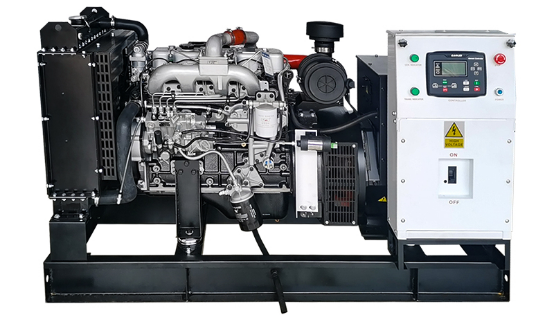
Open frame diesel generator — fully exposed engine and alternator make fault-finding, filter changes, and sensor checks faster and safer.
Symptoms: high coolant temperature alarm, steam from the radiator, derating or shutdown in hot weather.
Cause: low coolant, blocked radiator fins (dust, cottonwood, insects), a failed thermostat or water pump, a slipping fan belt, or — very commonly in enclosed sets — a canopy whose air inlet or outlet is blocked by vegetation, walls, or stored material. Ambient temperatures above the genset's rated maximum (typically 40–50°C) also push an otherwise healthy machine into overheat territory.
Fix: restore airflow first: clear fins and both enclosure apertures, keep at least 1–1.5 meters of clearance around canopy openings. Check coolant concentration (50/50 glycol mix), tension or replace belts, and test the thermostat. If the site regularly exceeds the rating, specify a derated sizing or a high-ambient package sized for your climate.
Symptoms: voltage reads low, fluctuates, or collapses when loads connect; equipment downstream complains of flicker or resets.
Cause: a failing Automatic Voltage Regulator, worn carbon brushes on older excitation designs, loss of residual magnetism after long storage, poor connections in the sensing leads, or an alternator that has suffered moisture ingress. Voltage sag under load can also indicate the load simply exceeds the set's rating.
Fix: check all terminal connections, then test the AVR's sensing circuit; many digital AVRs can be replaced as a plug-in module within an hour. If residual magnetism is lost, field-flash the exciter per the manual. Recurring AVR failures on cheap sets are a design warning — quality three-phase diesel generator packages use industrial-grade AVRs rated for continuous vibration and heat, which is one more reason to check alternator grade before purchase rather than after.
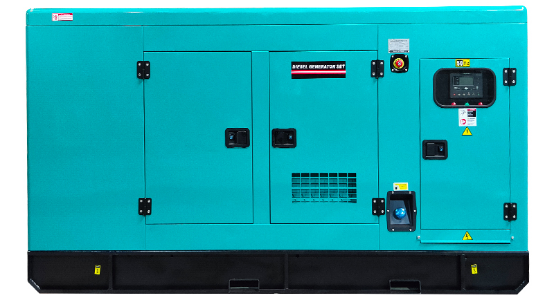
100kW silent diesel generator — a digital AVR holds output within ±1%, and the controller logs every voltage event for fast diagnosis.
Symptoms: the engine speed oscillates audibly (rev up, rev down) even at steady load; frequency readout swings; lights flicker.
Cause: governor instability, air or water passing through the fuel system, restricted fuel filters, clogged fuel-tank vent creating vacuum, or incorrect gain settings on electronic governors after a controller swap. Unbalanced or severely non-linear loads can also provoke oscillation on marginal alternator packages.
Fix: purge air from the fuel lines and replace filters; verify the tank breather. On electronic governors, restore default gains and tune per the manual. If hunting persists across loads, involve a technician — sustained oscillation accelerates wear on every coupled component and damages frequency-sensitive equipment downstream.
Symptoms: main breaker trips shortly after load transfer; controller logs over-current or overload events.
Cause: genuine overload — often because new equipment was added since the original sizing — or a locked-rotor motor (a jammed pump or compressor draws 6–8× rated current), a short circuit downstream, or a breaker that has weakened with age and heat cycling.
Fix: compare the connected load with the nameplate rating and re-verify the sizing arithmetic; motor-starting loads, not just running loads, must fit within the set's capability. Insulation-test suspect cabling and motors to rule out shorts. If the set is genuinely undersized, the honest solution is a larger machine or a properly configured auto-start diesel generator pair with load-shedding — not repeated manual breaker resets, which hide the real problem until something burns.
Symptoms: visible smoke changes that owners often report before any alarm appears.
Smoke color is your earliest free diagnostic. A brief puff of white on cold start-up is normal; steady colored smoke under load always has a mechanical cause worth investigating the same week.
Symptoms: the set runs fine at sea level but cannot carry its nameplate load at the mountain site; derates on hot afternoons.
Cause: physics, not fault. Naturally aspirated engines lose roughly 1% of power per 100 meters of altitude and about 1% per 5°C above rated ambient, because thinner, hotter air carries less oxygen per cylinder charge.
Fix: size for the site conditions at purchase time — specify turbocharged/aftercooled engines and apply proper derating factors. Longhong's Weichai generator operating at 5,300 meters in a mining area demonstrates what correctly derated, properly specified equipment achieves at extreme altitude. If a set is already installed and underperforming, the fix is a capacity review, not parts replacement.
Symptoms: black wet residue at the exhaust, fuel dilution in the oil, fouled injectors, dropping output over months — on a set that "never runs long."
Cause: diesel engines are designed to work. A standby diesel generator that only receives brief no-load test runs each month runs cold, and unburnt fuel plus carbon accumulate in the exhaust system and cylinders. This is wet stacking, and it quietly ruins gensets sized far above their real load.
Fix: run monthly tests with a load bank (or real building load) of at least 30% of nameplate — ideally 50–80% — for 30–60 minutes to reach full operating temperature and burn out deposits. If the actual building load can never reach that band, right-size the machine or specify a smaller companion set. When buying, match capacity to real demand rather than inflating "for safety," because oversizing is itself a failure mode.
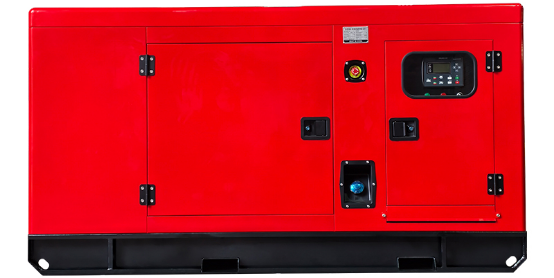
80kW silent diesel generator under scheduled load testing — monthly runs at 50–80% of rating are the definitive cure for wet stacking.
| Fault | Most Likely Cause | First Action |
|---|---|---|
| Won't crank | Battery discharged/faulty | Test battery voltage, clean terminals, check charger |
| Cranks, won't start | Fuel starvation / air in system | Verify fuel level, replace filters, bleed system |
| Low oil pressure | Low level / wrong grade / sensor | Check level; verify with manual gauge |
| Overheating | Airflow blocked / low coolant | Clear radiator and canopy vents; check coolant |
| Low/unstable voltage | AVR or sensing connection fault | Check terminals; replace/test AVR module |
| Frequency hunting | Air in fuel / governor settings | Bleed fuel lines; restore governor defaults |
| Breaker trips | Overload or locked-rotor motor | Audit connected load; insulation-test circuits |
| Black smoke | Dirty air filter / overload | Replace air filter; reduce load |
| White smoke | Water in fuel / cold start | Drain separator; test fuel quality |
| Blue smoke | Oil consumption (rings/valve guides) | Check oil level; compression test if persistent |
| Underpowered at site | Altitude/temperature derating | Apply derating factors; resize set |
| Wet stacking | Chronic under-loading | Monthly 50–80% load-bank runs |
Site teams can safely handle the checks that need no electrical exposure: fuel level, battery terminals and voltage, coolant level, radiator and vent cleaning, filter changes, belt tension, and reading controller event logs. Call qualified service in these cases:
One discipline rule above all: find and fix the root cause. Resetting alarms without correcting the fault converts a 30-minute repair into a seized engine, and on an industrial emergency diesel generator the difference is measured in production downtime.
Nearly every fault in this list is either maintenance-related or quality-related — which is to say, preventable. On the maintenance side: run the engine weekly under load, log coolant/oil/battery checks daily on critical sets, exercise the ATS monthly, and load-bank test annually. On the quality side, the cheapest genset is rarely the cheapest machine: genuine engines from Cummins, Weichai, Yuchai, Perkins, and Volvo, matched copper-wound brushless alternators with digital AVRs, and industrial controllers eliminate the recurring failure patterns that plague budget packages.
Guangdong Longhong Electromechanical Equipment Co., Ltd. builds every diesel generator set — from the 24kW silent model to the 100kW industrial unit and the 64kW automatic-start configuration — with genuine engines, digital AVR control, and a full-load test before dispatch. Our 400KW/500KVA Yuchai silent installation and export projects across Tanzania, Libya, Cambodia, Vietnam, and Myanmar run the same tested architecture. You can review the CE and ISO certification portfolio and the complete 3KVA–3000KVA product catalog online, or learn about the factory that keeps 200+ units in permanent stock for fast delivery.
Diesel generator troubleshooting follows a simple logic: read the controller history, verify the basics (fuel, air, battery, coolant), and let the symptom pattern — no-start, smoke color, voltage behavior, temperature — lead to the subsystem at fault. Ten fault patterns cover nearly every service call you will ever face, and disciplined weekly running, clean fuel, exercised batteries, and honest load testing prevent most of them from ever occurring. When a fault does repeat, treat it as information about the machine's quality — and choose your next diesel power generator accordingly, from a manufacturer who tests before shipping and stands behind the components inside.


