

 English
 العربية
 Español
 Русский
Industry News
Industry News

When the power fails in a textile plant, the damage starts within minutes. Spinning frames stop mid-spin and thousands of yarn ends break at once; air-jet looms leave fault picks across the fabric; dyeing machines hold loads at the wrong temperature and the batch is rejected; compressed-air systems bleed down and every downstream machine stops. For a spinning, weaving, knitting or garment factory, a properly specified diesel generator set is not an accessory — it is the line of defence that protects machine uptime, fabric quality and delivery dates. This guide explains how buyers in the textile sector should assess loads, size a standby diesel generator, choose between enclosure types, and buy from a China diesel generator manufacturer with confidence.
Textile manufacturing is a continuous, machine-dense process. Unlike a warehouse or an office, where an outage means lights and computers, a spinning mill loses product when power drops. Consider the typical consequences:
Ring frames and open-end machines depend on constant spindle and rotor speeds. A two-second dip can break yarn ends across an entire machine. Restarting requires operators to piece thousands of ends by hand — hours of labour, plus a spike in second-quality yarn. Many spinning plants report that a single uncontrolled outage can erase an entire shift's margin.
Air-jet and rapier looms that stop under load mark the fabric with stop marks and wrong pick densities. In dyeing and finishing, an outage that halts circulation or heating mid-cycle can ruin the batch — dyeing machines often run for hours at controlled temperature, and there is no way to "resume" a failed batch.
Textile halls maintain relative humidity (typically 55–65% for spinning) using centralized HVAC and misting systems, and looms depend on a stable compressed-air supply. Both systems are motor-driven and both stop instantly in an outage. Re-establishing humidity takes hours, and without air pressure no loom runs at all.
For these reasons, textile buyers typically specify an industrial emergency diesel generator that starts and transfers automatically, sized not just for essential lighting but for the productive core of the plant.
Good sizing begins with an honest load inventory. Textile plants usually break down into four categories:
The single most important technical detail is motor starting. Compressors, boiler feed pumps and humidification fans are frequently started direct-on-line (DOL), and a DOL motor draws 6–8 times its rated current at start. If your generator is sized only against running load, it will bog down or trip the moment a large compressor restarts. Three fixes exist, in order of preference:
Voltage and frequency matter too. Textile machinery with electronic controls, inverters and servo drives is sensitive to voltage dips and waveform distortion; specify an alternator with a quality AVR (automatic voltage regulator) and low harmonic distortion, and keep the generator loaded in the 50–80% band where regulation is best.
Use a three-step calculation:
List every machine that must run during an outage, with its rated input in kW. A mid-sized knitting and dyeing plant might look like this:
| Load | Running kW | Start Method | Starting Surge Contribution |
|---|---|---|---|
| Knitting machines (30) | 75 | VFD | +15 |
| Air compressor 55 kW | 55 | Soft starter | +110 (brief) |
| Dyeing machines / pumps | 45 | DOL (small) | +90 (brief) |
| Humidification plant | 30 | Soft starter | +60 (brief) |
| Lighting, fans, offices, IT | 25 | — | — |
Running total is 230 kW, but the largest single start (the 55 kW compressor soft-starting) adds a temporary surge. Generators handle surge in kVA; a practical rule is to ensure the genset's prime kVA rating covers running kVA plus roughly 30–40% of the worst motor-start spike, and its standby rating covers the full surge for the seconds it lasts. In this example, a machine in the 300–400 kVA class with a soft-starter-equipped compressor, or one size larger with DOL starting, is the right neighbourhood.
Divide kW by the power factor (0.8 for most industrial gensets). 300 kW ÷ 0.8 = 375 kVA. Round up to a standard frame, then confirm the unit meets both the surge (standby) requirement and the continuous running requirement at 50–80% load. Undersized generators suffer wet stacking and shortened engine life; grossly oversized ones run inefficiently. A balanced specification is what you should expect from a competent China diesel generator factory during quotation — if a supplier quotes a size without asking about your compressor starts, that is a red flag.
As a reference band: a 10,000-spindle spinning plant commonly lands in the 500–800 kVA range, a mid-size knitting/dyeing plant in the 250–500 kVA range, and a garment-cutting-and-sewing factory (mostly lighting and small motors) between 50 and 200 kVA. Our own reference installations illustrate the upper end of this scale — see the 400KW/500KVA Yuchai silent generator project and the Libya 750KVA Cummins export case.
Textile plants come in many building shapes, and so do generators.
An open frame diesel generator is the most economical choice where the unit lives in a dedicated, ventilated generator room with acoustic treatment. It is easier to service, cooler-running and cheaper — the standard answer for purpose-built power houses in industrial parks. The trade-off is noise: open frames typically produce 95–105 dB(A), so they belong behind a wall, not in the production hall.
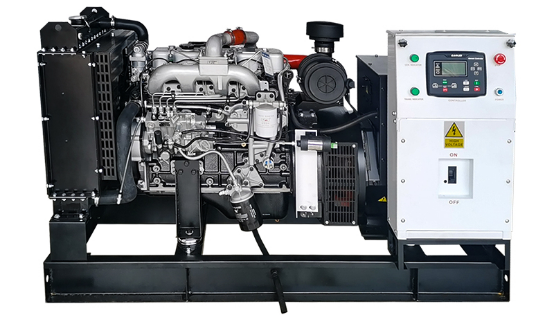
Open frame diesel generator sets suit dedicated generator rooms with proper ventilation and acoustic treatment.
A canopy diesel generator (silent type) wraps the genset in a weatherproof, sound-attenuated enclosure, typically reducing noise to 65–75 dB(A) at 7 metres. For factories located inside mixed-use zones, or where the generator sits outdoors beside the production hall, the silent canopy is the default recommendation. It also simplifies rain and dust protection and speeds up installation — crane it into place, connect fuel, cables and exhaust, and run.
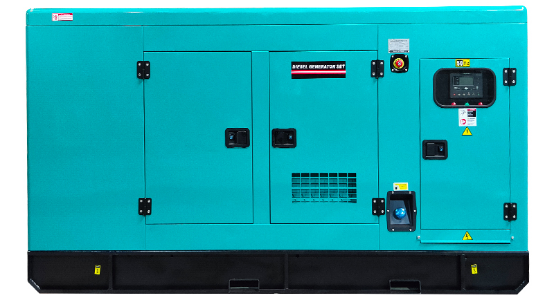
A 100kW silent canopy diesel generator — the workhorse size for small and mid-size garment factories. View the 100kW diesel generator specification.
Containerized gensets combine high ratings with a walk-in, weatherproof, sound-attenuated enclosure, integrated fuel tanks and easy transport. For large spinning mills and for sites that may relocate machinery across plants, a containerized set is often the better long-term investment than site-built generator rooms.
A mobile trailer diesel generator earns its keep where the plant has seasonal peaks, multiple sheds, or construction phases — one trailer-mounted unit can serve several buildings, or be hired out during shutdown weeks. It also provides instant capacity while a permanent genset is being serviced.
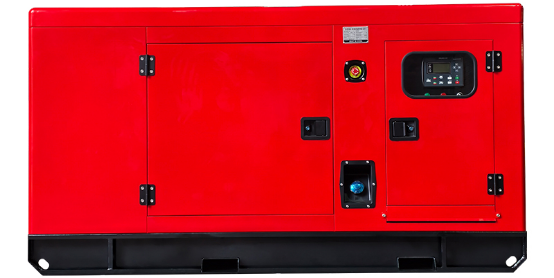
The 80kW silent diesel generator is a popular size for weaving sheds and dye-house support loads.
In a textile plant, the difference between a nuisance trip and a production incident is usually seconds. Specify:
For smaller satellite buildings — a fabric store, a dormitory, a gatehouse — a compact three-phase unit is usually all that is needed. Typical choices include the 32kW silent generator, the 24kW silent diesel generator and the 10-14kW silent generator for the smallest loads.
Diesel consumption for a well-matched industrial genset runs roughly 0.25–0.30 litres per kWh produced at partial load, and less at the 75% sweet spot. Practical autonomy planning for textile plants:
Running cost arithmetic is straightforward: a 375 kVA unit producing 240 kW at 75% load consumes roughly 65–70 L/h. Compare that against the hourly value of production lost in a stopped spinning plant and the economics of a properly sized standby set resolve themselves quickly.
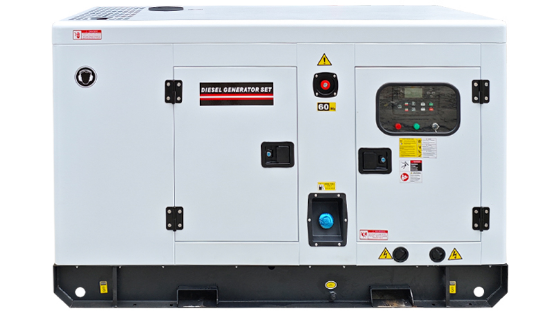
A 32kW three-phase silent genset covers stores, dormitories and auxiliary buildings economically.
China produces some of the most cost-effective industrial diesel gensets in the world, but quality varies enormously between suppliers. Before you place an order, work through this list:
Longhong checks every box on that list. As a Guangdong-based diesel generator manufacturer established in 2010 with over 20 years of engineering experience behind its team, the company builds sets from 3KVA to 3000KVA powered by Cummins, Weichai, Yuchai, Perkins, Volvo and Yunnei engines, holds CE and ISO certification, keeps a permanent stock of 200+ units for fast delivery, and has exported to Cambodia, Vietnam, Myanmar, Tanzania, Libya and beyond — including a 100KVA Cummins genset commissioned in Tanzania.
For spinning, weaving, knitting and garment plants, a standby diesel generator is production insurance with a measurable payback: every hour of covered uptime protects yarn quality, fabric batches and delivery commitments. Size against your real load inventory with motor-starting surges included, choose the enclosure that matches your building and site, insist on auto-start with a quality ATS and AVR, and buy from a manufacturer who will put duty ratings, genuine engine brands and load-test reports in writing. When you are ready to specify, review the full range of Longhong diesel generator sets or contact Longhong Power for a quotation matched to your plant's load profile.
About Guangdong Longhong Electromechanical Equipment Co., Ltd.
Founded in 2010 in Guangdong, China, Longhong Electromechanical is a professional diesel generator manufacturer with 20+ years of industry experience. The company produces diesel generator sets from 3KVA to 3000KVA — open frame, silent/canopy, trailer and containerized types — powered by Cummins, Weichai, Yuchai, Perkins, Volvo and Yunnei engines, all CE and ISO certified, with 200+ units in permanent stock and exports to Southeast Asia, Africa and the Middle East. Learn more at https://www.longhongpower.com/.


