

 English
 العربية
 Español
 Русский
Industry News
Industry News

When the grid fails at a busy distribution warehouse, the clock starts immediately. Conveyor lines freeze, forklift charging stalls, and — most expensively — the refrigerated dock starts climbing toward unsafe temperatures. For logistics operators, a properly sized diesel generator set is not an accessory; it is the insurance policy that keeps orders shipping and inventory safe. This guide explains how warehouse and logistics center buyers in export markets can assess loads, choose between enclosure types, integrate auto-start controls, and source a dependable unit from a China diesel generator manufacturer without overpaying.
Guangdong Longhong Electromechanical Equipment Co., Ltd. has manufactured diesel gensets in Guangdong since 2010, with engine options from Cummins, Weichai, Yuchai, Perkins, Volvo, and Yunnei, outputs from 3KVA to 3000KVA, and more than 200 units in permanent stock for fast dispatch. You can review the full range on the product catalog.
Modern logistics facilities concentrate several failure-sensitive systems under one roof: refrigeration and cold-dock compressors, battery-charging banks for electric forklift fleets, WMS servers and scanning networks, security and fire systems, and dock-door motors. Outage costs stack up in three ways.
For warehouses handling chilled or frozen goods, a two-hour outage can push product temperatures outside HACCP or GDP tolerance, turning sellable inventory into a write-off. A standby diesel generator rated for automatic transfer keeps compressors running through short grid events without staff intervention.
Sorting lines, label printers, and lift-gate power all stop when the lights do. Shifts idle, SLA penalties accumulate, and catch-up overtime erodes margins. An emergency diesel generator with a 10-second auto-start turns a grid failure into a non-event for most operations.
Cross-dock operations and bonded warehouses often run 24/7; a stalled yard cannot offload trucks. Losing WMS connectivity mid-shift corrupts picking sequences. Keeping servers and network switches on the generator-backed bus protects both data and dock schedule.
Before requesting quotes from any diesel genset supplier, classify every load into three tiers. This prevents the most common sizing error — buying a unit big enough for everything, when only critical loads need to ride through an outage.
Emergency lighting, fire alarm panels, fire pumps, and refrigeration for regulated goods. These must connect to the generator-backed bus without exception. Fire pumps deserve special attention: their starting inrush is large and their load is legally non-negotiable.
Refrigerated docks, conveyor and sorter drives, forklift charging, WMS servers, network equipment, and dock-door operators. Keeping Tier 2 powered preserves shipping throughput and inventory value.
Office HVAC, staff amenities, and decorative lighting. These can be left on the raw grid side, or placed on a manual transfer switch to shed during extended outages. Shedding Tier 3 often lets a buyer select a genset one frame size smaller — a direct capital saving.
Motor-driven equipment is the sizing driver in warehouses. Compressors and conveyor drives draw 2 to 6 times their running current at start-up, depending on the starter type. A practical method:
Suppose the facility carries a 12 kW cold-dock compressor bank (DOL, staged), a 7.5 kW conveyor drive (VFD), an 11 kW fire pump (DOL), 15 kW of forklift chargers (VFD), and 8 kW of servers and network gear. Running total is about 53 kW. With DOL staging handled by the controller and VFDs softening the rest, a starting peak of roughly 90–100 kW is manageable. Selecting the next frame up with surge headroom, an 80–100 kW class diesel generator fits the duty. For a mid-size unit with automatic transfer, see the 64 kW auto-start diesel generator, which covers Tier 1 plus a reduced Tier 2 strategy for smaller depots. Buyers running the numbers down to refrigerated-dock-only protection often land in the silent 80 kW class for larger sites, or the 32 kW silent generator for single-cold-room storage.
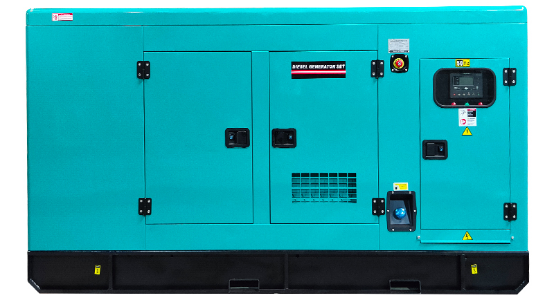
Caption: A 100 kW silent canopy diesel generator set — a common choice for distribution warehouse backup power.
Most industrial warehouses in export markets run three-phase distribution for motors, while offices and small equipment use single-phase. Match the genset to the site bus:
A three-phase genset can serve single-phase loads if phases are balanced within the alternator's limits — but a single-phase genset cannot serve a three-phase motor bus. When in doubt, configure three-phase and note the requirement clearly in your purchase contract. Longhong ships both configurations and confirms voltage/phase during factory load testing; see the company profile for manufacturing details.
A canopy diesel generator is the default for warehouses near residential zones or office parks. Acoustic canopies typically achieve 65–75 dB(A) at 7 meters, weatherproof the unit for outdoor pad installation, and include internal silencers. For a logistics park where the genset sits 15 meters from a neighbor's fence, canopy is the pragmatic answer.
Large distribution centers and 24/7 cross-docks often choose a containerized diesel generator: integrated fuel tank for extended autonomy, better noise control, and weather protection for permanent outdoor installation. Container formats also simplify crane handling and security fencing.
An open frame unit suits indoor plant rooms with their own ventilation, or temporary yard power during building modifications. It costs less and is lighter, but requires a sheltered, ventilated location and delivers full noise to the surroundings. Browse Longhong's homepage for the enclosure range and current stock.
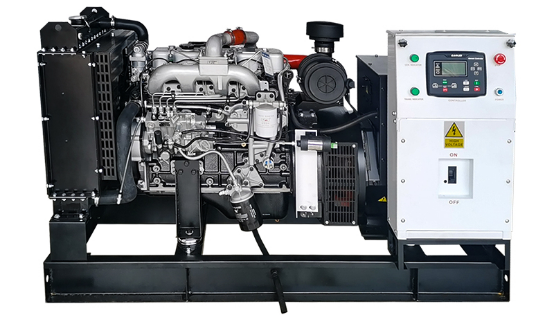
Caption: Open frame diesel genset — economical choice for ventilated indoor plant rooms.
Warehouses fail at 3 a.m. as often as at midday. Manual start-up defeats the purpose of standby power. Specify:
Longhong's 64 kW auto-start model ships with AMF functionality as standard; the specification page is here: 64 kW automatic generator. UPS units should back only WMS servers and network gear — do not place compressor inrush on the UPS bus.
Plan autonomy by multiplying expected load factor by specific consumption. A typical diesel genset burns roughly 0.25–0.30 liters per kWh produced. A 100 kW unit running at 70% load consumes about 18–21 liters per hour, so a 1,000-liter base tank delivers roughly two days of continuous operation. For hurricane-season regions or areas with slow utility restoration, add an external day tank and a refueling contract. Store fuel with a polishing plan — diesel degrades in 6–12 months without treatment, and stale fuel is a leading cause of failed starts during real emergencies.
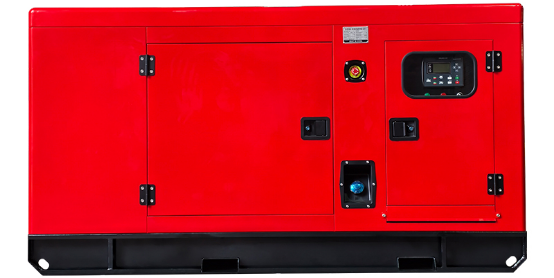
Caption: An 80 kW silent canopy genset balances capacity and yard-space footprint for mid-size warehouses.
China remains the world's most cost-competitive source for mid-range diesel gensets, but quality varies between suppliers. Before transferring funds:
Longhong's certifications and quality documentation are available on the qualifications page. For buyers protecting smaller storage sites or retail stockrooms, the 20 kW silent diesel generator and the 10–14 kW compact silent unit cover single-cold-room and small-building duties at minimal capital cost.
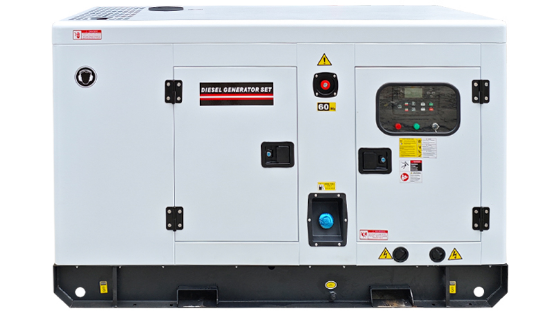
Caption: A 32 kW silent diesel generator protects small warehouses and refrigerated storage rooms.
A warehouse diesel generator is sized not by floor area but by the loads that must survive an outage: refrigeration compliance, motor-starting surge, and the controls that make the whole sequence automatic. Classify loads into three tiers, apply motor-starting multipliers honestly, target a 50–80% running band, and choose the enclosure that fits your site's noise and weather reality. With those numbers in hand, sourcing from a stock-holding China manufacturer becomes a straightforward comparison of engine brand, warranty, and delivery time — and Guangdong Longhong Electromechanical Equipment Co., Ltd. is ready to quote against your load list.
About Guangdong Longhong Electromechanical Equipment Co., Ltd.
Founded in 2010 and based in Guangdong, China, Longhong manufactures diesel generator sets from 3KVA to 3000KVA powered by Cummins, Weichai, Yuchai, Perkins, Volvo, and Yunnei engines. Product types include open frame, silent canopy, mobile trailer, and containerized units, all CE and ISO certified, with 200+ units in permanent stock and exports to Cambodia, Vietnam, Myanmar, Tanzania, Libya, and beyond. Explore the full range at https://www.longhongpower.com/products_27/.


