

 English
 العربية
 Español
 Русский
Industry News
Industry News

Noise is one of the most underestimated criteria when buyers source a diesel generator set from a China diesel generator manufacturer. A genset that is perfectly sized and priced can still be rejected by neighbors, regulators, or site inspectors if it is too loud. Understanding decibel (dB) ratings, what they are measured against, and how enclosure design changes sound output will help you specify the right machine — usually a silent diesel generator with a canopy — and avoid costly retrofits. This guide explains how noise is measured, which dB levels apply to which environments, how canopy construction actually reduces sound, and what to check when buying from a China source factory.
Generator noise is expressed in decibels, but two details decide whether a published figure is honest. The first is the reference distance. Manufacturers typically quote sound pressure at 7 meters (23 ft), following ISO 3744 test procedures, while some quote at 1 meter. A unit rated 75 dB(A) at 7 m is dramatically louder if that figure were actually measured at 1 m — always confirm the distance before comparing quotes.
The second detail is weighting. Sound level meters apply an "A-weighting" curve that approximates human hearing, written as dB(A). This matters because a diesel engine's dominant frequencies are low-frequency rumbles that A-weighting penalizes less than high-frequency whine. For context, here are common reference levels:
The decibel scale is logarithmic: every 10 dB reduction is perceived as roughly half the loudness. So moving from a 98 dB(A) open frame to a 70 dB(A) canopy generator is not a modest improvement — it is the difference between "unbearable without ear protection" and "tolerable conversation-level background hum." This is why a 80kW silent diesel generator with a well-engineered enclosure is the default choice for most standby and prime power applications today.
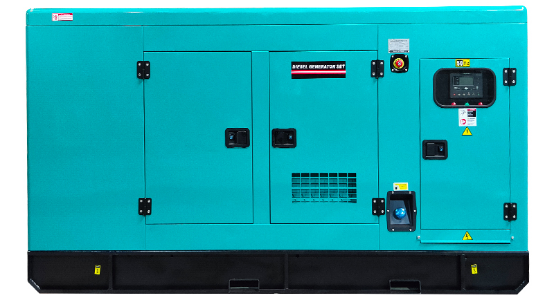
A 100kW silent diesel generator — the soundproof canopy brings 7-meter noise down to the 70 dB(A) range, suitable for commercial and light-industrial sites.
Residential noise ordinances in most countries restrict nighttime sound at property boundaries to roughly 45–55 dB(A), and some cities are stricter. A standby diesel generator serving a hotel, apartment block, or clinic therefore cannot simply be a big engine in a box. The practical target is 65 dB(A) or better at 7 m from the machine, combined with distance, barriers, and exhaust silencers to bring the boundary reading below the legal limit. For a guest-facing property, noise failure means complaints and refunds; specify a canopy unit and verify measured data, not marketing claims.
Construction site diesel generator set noise rules are looser but real: many jurisdictions cap daytime site noise at 75–85 dB(A) at the site boundary, with tighter evening and weekend limits. Because a canopy construction generator also protects the machine from dust, rain, and theft, most contractors now order canopy diesel generator configurations even where an open frame would technically be cheaper. A 32kW silent diesel generator powering site cabins, lighting, and small tools is a typical configuration for urban projects.
Heavy industry and quarry diesel backup power supply installations usually face workplace exposure limits (typically 85 dB(A) over an 8-hour shift for workers) rather than strict boundary limits. Here an 100kW industrial diesel generator in a canopy, or even a larger open-frame unit inside a purpose-built generator house with acoustic treatment, is normal. The engineering question shifts from "how quiet is the machine" to "how quiet is the room."
Event organizers, wedding venues, and film crews are the most demanding buyers: conversation, recording, and audience comfort require generators effectively inaudible beyond 15–20 meters. This pushes selection toward the quietest canopy ratings (65 dB(A) or lower at 7 m), trailer-mounted units parked away from the stage, and sometimes additional temporary acoustic screens.
Not all canopies are equal. When you evaluate a silent diesel genset from any supplier, look inside the enclosure design rather than at the dB sticker. Five elements do the actual work:
Quality canopies line the inner walls and roof with rock wool or glass wool of sufficient density and thickness (commonly 50–100 mm), protected by a perforated galvanized or aluminum facing. Thin, low-density foam saves cost and loses performance quickly as it ages or absorbs oil mist.
A genset needs large volumes of cooling air — and every air path is a sound leak. Good enclosures route intake and discharge air through baffled, multi-turn labyrinth passages lined with absorptive material. Cheap canopies cut straight openings for airflow and quietly give back 5–10 dB of the sound they promised on the datasheet.
The exhaust is the single loudest source. Residential-grade canopies use hospital-type or super-critical grade silencers that attenuate 25–35 dB. Check that the silencer is mounted inside the canopy, with flexible bellows connecting it to the engine to prevent vibration transmission into the skin of the enclosure.
Engine vibration transferred into the base frame and canopy panels turns the whole enclosure into a sound radiator. Effective designs isolate the engine-alternator assembly on rubber or spring mounts, and the canopy itself on heavier mounts within the steel base frame.
Door gaskets, louvered seals, and panel overlap all matter. A canopy that rattles or leaks light usually leaks noise too. Ask to see photos or video of door seals and paint quality — surface details reveal how seriously the factory takes the whole enclosure.
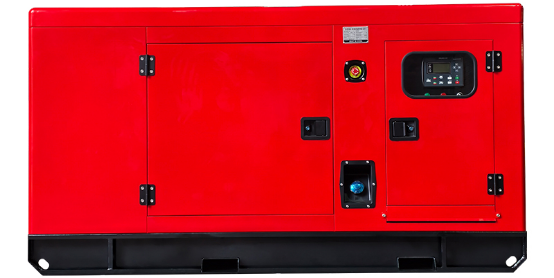
An 80kW canopy diesel generator: layered acoustic insulation, baffled airflow, and an internal super-silencer are what deliver the rated dB figure.
The genset you buy sets the starting dB level; where and how you install it decides the final reading at the boundary. Four proven tactics:
Remember that a genset also must breathe. Never enclose a canopy in a sealed shed; every silencing measure must preserve airflow or the unit will overheat and derate. Reputable manufacturers like Guangdong Longhong provide ventilation sizing guidance with their canopy generators precisely for this reason.
Noise needs vary strongly with rating, and smaller silent sets are usually quieter per the same enclosure technology. Typical figures from well-built canopies:
| Rating Class | Typical 7 m Noise (Canopy) | Typical Applications |
|---|---|---|
| 10–14kW | 62–68 dB(A) | Homes, small shops, site cabins — see the 10-14kW silent generator |
| 16–32kW | 65–72 dB(A) | Restaurants, clinics, farms, small construction sites — e.g. the 32kW silent diesel generator |
| 40–100kW | 68–75 dB(A) | Hotels, malls, factories, larger sites — e.g. the 80kW silent generator |
| 250–3000kVA | 75–85 dB(A) | Industrial plants, data centers, power stations; noise handled by enclosure design and plant room treatment |
Two practical notes for buyers. First, noise grows with load: a genset at 75% load is audibly louder than the same unit idling, so ask for measured noise at a defined load, not just a best-case figure. Second, noise discipline travels with the whole product family: a factory that builds quiet 30kW silent generators for farms and 24kW residential sets usually applies the same insulation standards across its range, which is one reason it pays to review a supplier's certifications and qualifications before ordering.
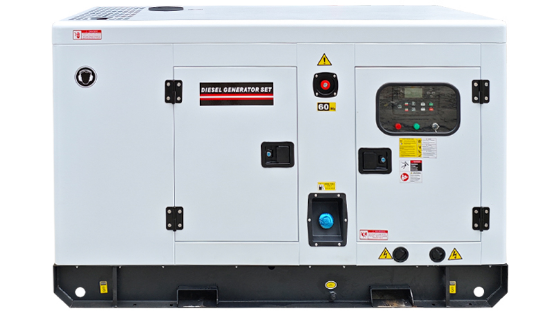
A 32kW silent diesel generator — in the 65–72 dB(A) class, the workhorse rating for clinics, restaurants, farms, and construction site cabins.
China supplies a large share of the world's emergency diesel generators and portable power units, and enclosure quality is where low-cost and high-quality factories separate. Before placing an order, put these items on your checklist:
Guangdong Longhong Electromechanical Equipment Co., Ltd. has built canopy and containerized silent generators since 2010, with Cummins, Weichai, Yuchai, Perkins, Volvo, and Yunnei engine options from 3KVA to 3000KVA, CE and ISO certification, and more than 200 units in permanent stock for fast export — units that have shipped to Cambodia, Vietnam, Myanmar, Tanzania, and Libya.
Noise is a specification, not an afterthought. Decide the dB limit your site, neighbors, or regulator impose, then work backward: a quality silent canopy diesel generator rated 65–75 dB(A) at 7 m, installed with attention to distance, orientation, barriers, and airflow, will meet almost every commercial and residential requirement. When comparing quotes from any diesel genset supplier, demand measured noise data at a stated distance, inspect the enclosure construction, and treat the canopy as seriously as the engine — because in many installations, the enclosure is what the neighbors actually hear. Choose a manufacturer that engineers both, and your power generator will stay heard-but-not-noticed for the next decade of standby duty.
About Guangdong Longhong Electromechanical Equipment Co., Ltd.
Established in 2010 in Guangdong, China, Longhong is a professional diesel generator manufacturer with 20+ years of industry experience, producing open frame, silent/canopy, trailer, and containerized diesel generators from 3KVA to 3000KVA powered by Cummins, Weichai, Yuchai, Perkins, Volvo, and Yunnei engines. CE and ISO certified, with 200+ units in permanent stock and exports to Cambodia, Vietnam, Myanmar, Tanzania, Libya, and beyond. Visit www.longhongpower.com to browse the full range and request a quotation.


