

 English
 العربية
 Español
 Русский
Industry News
Industry News

When an EPC contractor mobilises a crew into a mining concession, a telecom operator rolls out a tower cluster, or a humanitarian agency sets up a field hospital after a flood, the first engineering question is the same: where does the power come from? In most cases the answer is a mobile trailer diesel generator — a fully integrated genset on a wheeled chassis that can be towed behind a 4×4 pickup, parked on unprepared ground, and switched on within minutes. This guide, written by Guangdong Longhong Electromechanical Equipment Co., Ltd., a China diesel generator manufacturer with two decades of export delivery, walks procurement teams, project managers, and rental-fleet owners through the decisions that determine whether a trailer type construction site generator performs reliably for ten years or fails in the second season.
Three engineering realities converge on the trailer format for off-grid work:
A skid-mounted genset requires a flat concrete plinth, earthing rods, and a crane to unload. A mobile trailer diesel generator only needs a pickup truck, a level patch of ground, and a fuel source. In disaster relief deployments — typhoon recovery in the Philippines, earthquake response in Türkiye, monsoon flooding in Bangladesh — hours of downtime translate directly into lives lost. Trailer units cut the install-to-load timeline from days to under thirty minutes.
Most remote engineering projects are not permanent: a road-construction contract may last 18 months, a mine camp 7 years, an oil & gas exploration well 6 months. The capital invested in a trailer-mounted diesel generator can be depreciated across multiple sites, whereas a fixed skid unit sits idle once the project closes. Long-term total cost of ownership is therefore typically 20–35% lower for trailer units over a 10-year horizon.
In most jurisdictions a trailer unit is registered as a road-going asset rather than fixed plant. That means it can be financed, insured, and depreciated on a vehicle asset schedule, and it can be moved across provincial or national borders without the customs and import-duty complications that apply to permanently installed diesel power plant equipment. A 400kW Yuchai trailer project is a typical example of a unit built to meet this dual road-and-site requirement.
A modern mobile diesel generator trailer is more than a generator on wheels. It is a fully engineered power module with eight integrated subsystems:
The prime mover (diesel engine) and the alternator are bolted to a common skid base inside a sound-attenuated canopy. Common ratings for trailer deployment range from 8kW single-phase to 500kW three-phase. The 100kW silent diesel generator and the 80kW silent canopy model are both popular mid-range configurations for trailer builds.
The canopy is typically a 2–3 mm steel enclosure with mineral-wool acoustic lining, lifting lugs, lockable access doors, and a residential-grade silencer on the exhaust. Quality canopies bring noise down to 65–75 dB(A) at 7 metres, which is critical for night-time operation in residential or camp environments.
Tank capacity for trailer units typically ranges from 100 L (8 hours at 75% load on a 30kW unit) to 1,000 L (24+ hours on a 200kW unit). Bunded (double-walled) tanks are mandatory in many markets to prevent soil contamination from leaks or rupture.
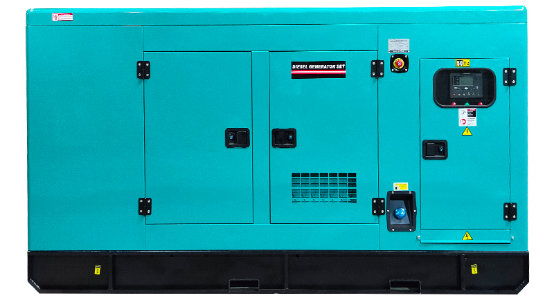
The chassis is the single most overlooked item on a trailer genset and deserves its own section below. Briefly: heavy-duty I-beam frame, single or tandem axle depending on gross weight, leaf-spring or torsion-bar suspension, road tyres, ball-hitch or pintle-hitch coupling, and a hand-operated or electric parking jack.
For trailer units that act as emergency diesel generator backup at unattended sites, an automatic transfer switch (ATS) and remote-monitoring module are typically specified. The 64kW automatic diesel generator ships with Deep Sea or Smartgen controllers that support remote start, mains-fail sensing, and GSM telemetry out of the box.
Trailer units typically include an MCCB (moulded-case circuit breaker) sized for the rated current, IEC 60309 industrial sockets for site loads, and a terminal block for hard-wired connection to a distribution board.
Trailer units must survive lifting onto flatbed trucks at border crossings and being dragged across rough terrain. Look for a single-point lift, four corner tie-down points, and forklift pockets in the chassis.
Every trailer diesel generator set specification starts with a load list. For each load item, record the running power (kW), starting power (kVA, accounting for motor inrush), voltage, phase, and duty cycle. A camp of 200 workers typically requires:
Lighting (LED, 0.3kW per room × 80 rooms): 24kW
HVAC split units: 60kW running, 180kW starting
Kitchen cold-room and freezers: 25kW running, 75kW starting
Water-pump sets: 15kW running, 45kW starting
Office IT, Wi-Fi, printers: 5kW
Total running: ~130kW; total inrush peak: ~330kW. The trailer unit must be sized at 150–180kW continuous with a 300kW+ peak capability — a typical silenced 200kW trailer genset rating.
Engines lose power as altitude rises (thinner air) and as ambient temperature climbs (radiator derating). A standard rule applied by every China diesel generator supplier is to derate by 1% per 100 m above 1,000 m and 4% per 10 °C above 25 °C. A 100kW genset at 3,000 m altitude in 45 °C ambient is actually delivering ~65 kW at the alternator terminals.
Trailer deployments almost always grow — additional rooms, an extra cold-room, a second water pump, an upgraded workshop. Spec the trailer at 25% above today's running load to avoid expensive re-sizing later. The 40kW export-rated diesel generator and the 32kW silent generator are commonly chosen for smaller camps and growing sites respectively.
The chassis is what makes a mobile trailer diesel generator mobile. Get this wrong and the unit becomes a stranded asset.
Calculate the wet weight (full fuel, oil, coolant, batteries) and add a 15% safety factor. Trailer units below 3,500 kg gross vehicle weight (GVW) can run on a single axle; above that, tandem axles are mandatory in most markets. Tyres must be rated for both highway speed (typically 80–100 km/h) and rough-terrain endurance.
50 mm ball hitches are standard for sub-3,500 kg units. Pintle hitches or 75 mm ring couplings are used for heavy-duty units above 5,000 kg. Confirm the tow-vehicle's towing capacity — a typical 4×4 double-cab pickup can tow 3,500 kg; heavier trailer units require a dedicated tractor unit.
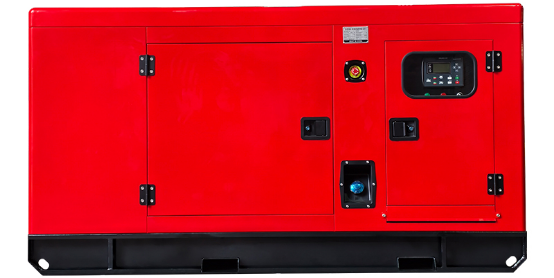
Overrun brakes (mechanical, activated by trailer momentum) are standard on light units. For heavy units, electric or hydraulic brakes with an in-cab controller are required. Always specify brake systems that match the destination country's vehicle code.
For cross-border movements, ensure the trailer carries a Certificate of Conformity (CoC), a weight plate, reflective markings, side-underrun protection (in EU/UK), and rear marker plates. Some jurisdictions also need a separate trailer registration document.
Four drop-down stabiliser legs at each corner of the chassis lock the unit in place on uneven ground and prevent rocking during operation. A small built-in spirit level is a low-cost feature that saves field-engineering time.
The engine you choose dictates service intervals, parts availability in the destination country, and fuel quality tolerance. Established China diesel generator manufacturers offer a wide engine menu precisely for this reason. The most common engine families in trailer gensets:
| Engine Family | Typical Trailer Range | Best For |
|---|---|---|
| Cummins (NTA855, QSX15) | 100–500kW | Global service network, mining |
| Perkins (4006, 4008) | 100–800kW | Europe, Africa, premium segment |
| Yuchai / Weichai | 20–400kW | Cost-optimised Asia / Africa |
| Volvo (TAD) | 150–500kW | Stage V emission compliance |
| Yunnei / Ricardo | 8–80kW | Small trailers, rural sites |
For trailer units deployed in countries with weak dealer networks, choose an engine brand with authorised distributors in the destination. Cummins and Perkins are the safest choices for Africa; Yuchai is widely supported across Southeast Asia; Yunnei and Weichai have growing networks in Central Asia. The Tanzania 100kVA Cummins distribution deployment shows how Cummins' service reach supports long-life trailer gensets in remote East Africa.
Trailer units deployed at altitude or in winter conditions need block heaters, oil-pan heaters, and low-temperature coolant. Without these, a Yuchai engine will struggle to start at –15 °C; a Cummins QSX with the cold-start package starts reliably to –25 °C. The Weichai generator deployed at 5,300 m in a mining area is a real-world example of altitude-engineered trailer service.
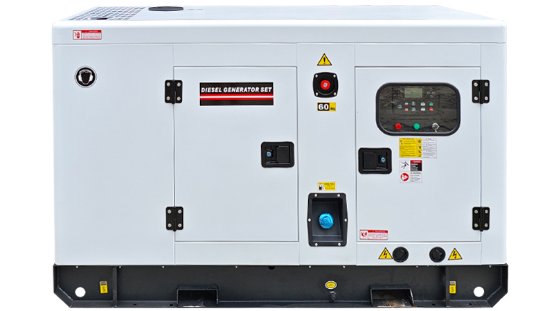
Trailer diesel gensets for night-time operation near residential or hospitality zones must respect local noise ordinances. Typical EU limits are 55–60 dB(A) at the property boundary. A good canopy achieves 65–75 dB(A) at 7 m from the unit, which translates to roughly 50–55 dB(A) at 25 m. For stricter limits, specify a super-silent canopy (60–65 dB(A) at 7 m).
Stage V (EU), EPA Tier 4 Final (US), and China NS VI engines are increasingly required. Older Tier 2 / Tier 3 units are still legal in most African, South American, and Southeast Asian markets but are being phased out. Confirm with the buyer which emission tier the destination country enforces.
Bunded base frames, drip trays, and fuel-capture systems are required in environmentally sensitive areas (national parks, near watercourses, food-production zones). Confirm with the supplier whether the standard trailer build includes a 110% bunded base.
Trailer units carry fuel — sometimes 1,000 L on a single unit. Specify fire extinguishers, spark arrestors on the exhaust, and thermal insulation on the exhaust manifold. Some jurisdictions also require flame-arrestor air intakes for underground mining deployments.
Diesel engines on trailer gensets should follow the manufacturer's service schedule strictly — typically every 250 hours for oil and filter changes, every 500 hours for fuel-filter and coolant checks, and every 1,000 hours for a major inspection. Field-service kits bundled with the unit should include:
One set of oil filters, fuel filters, and air filters per 500 hours
Engine oil sufficient for two services
Spare fan belts and AVR
Controller firmware and laptop diagnostic cable
Industry standard is 12 months from B/L date or 1,000 running hours, whichever comes first. Confirm in writing whether global warranty coverage is included. For trailer units exported to remote regions, warranty through the local engine distributor (Cummins, Perkins, Yuchai) is typically more reliable than warranty through the original equipment manufacturer (OEM) alone.
Air freight to a remote mining site can cost USD 5,000–10,000 per shipment and take a week. A 12-month spare-parts package bundled at order time is the cheapest insurance. A typical package for a 100kW trailer genset includes 4 oil filters, 4 fuel filters, 2 air filters, 1 set of fan belts, 1 thermostat, 1 water pump, and 1 set of injector nozzles.
For unmanned trailer units acting as emergency diesel generator backup, add a 4G/GSM module that reports running status, fuel level, fault codes, and GPS position. This dramatically reduces the cost of routine site visits and allows the rental operator to redeploy the unit before a fault becomes a site shutdown.
A credible China diesel generator manufacturer provides operation & maintenance manuals in English (and ideally the local language), engine service manuals, controller wiring diagrams, and a factory test report with load-test curves. On-site commissioning and operator training — even one day at handover — pays for itself many times over the unit's life.
A well-specified mobile trailer diesel generator can deliver ten or more years of reliable service across multiple remote engineering projects. Before signing a purchase order with any China diesel generator supplier, tick through this list:
Build the load list with running and starting kVA, voltage, and phase
Apply altitude and temperature derating — 1% per 100 m above 1,000 m; 4% per 10 °C above 25 °C
Add 25% headroom for project growth
Specify the trailer chassis — axle count, brake type, hitch type, stabiliser legs, road markings
Choose the engine brand with the strongest service network in the destination country
Confirm noise and emission tier — silent canopy with the right dB(A) rating, Stage V / Tier 4 if required
Bundle the spare-parts package for the first 12 months of operation
Confirm warranty — through both the OEM and the engine distributor
Add remote monitoring for unmanned deployments
Request a third-party pre-shipment inspection (SGS, Bureau Veritas, or TUV) for orders above USD 50,000
The trailer format turns a stationary diesel generator set into a flexible, redeployable asset that earns revenue across multiple sites. Start by reviewing the full Longhong product catalogue for trailer-format ratings, or contact the export team through the company profile to request a formal technical offer for your specific project.
Guangdong Longhong Electromechanical Equipment Co., Ltd. is a China diesel generator manufacturer founded in 2010 with more than 20 years of industry experience. The factory in Guangdong produces diesel generator sets from 3kVA to 3000kVA in open-frame, silent-canopy, containerized, and trailer formats, with engines from Cummins, Weichai, Yuchai, Perkins, Volvo, and Yunnei. The company holds CE and ISO certifications and keeps 200+ units in permanent stock for fast export delivery. Browse the 400kW Yuchai trailer deployment case study, or visit the company profile for export documentation.


